

loading

Category: KAT

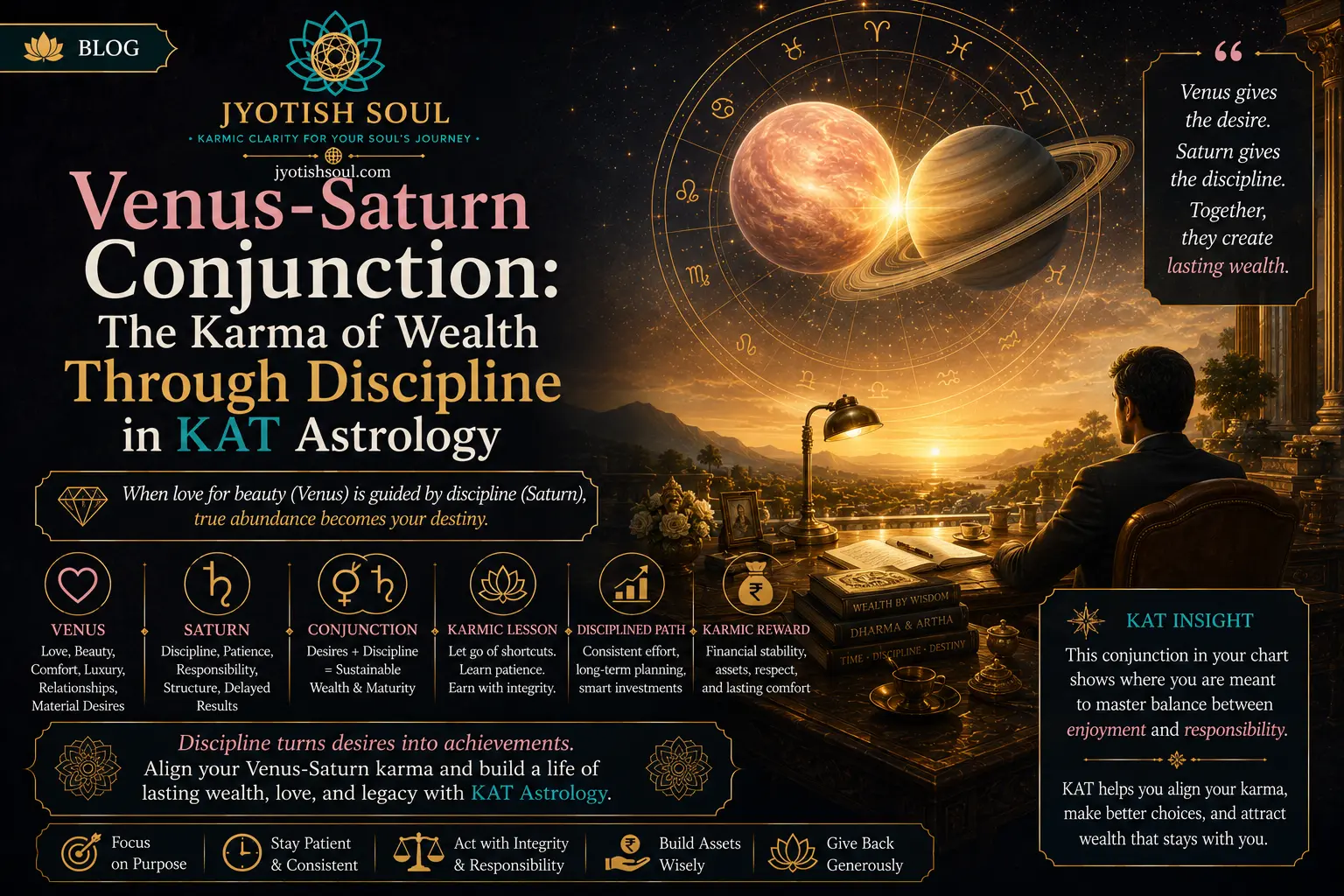
Venus-Saturn Conjunction: The Karma of Wealth Through Discipline in KAT Astrology

Spread the love

Some karmic combinations create friction. Venus-Saturn is different. This conjunction is widely considered one of the best placements for building a genuinely successful career and lasting wealth.

The reason is simple once you understand it. Saturn, the karma karaka, gets attached to Venus, the karaka of wealth itself. When the planet of discipline joins the planet of abundance, the result is wealth that comes through sustained, dedicated effort rather than luck alone.

Through KAT (Karma Alignment Technique), this conjunction reveals exactly how discipline and prosperity reinforce each other when properly aligned.


Venus and Saturn: Wealth Meets Discipline

Venus governs wealth, beauty, luxury, relationships, and pleasure. It represents what we value, what we find beautiful, and how comfort and abundance show up in our lives.

Saturn governs karma, profession, and the slow, disciplined effort required to earn lasting results. When Saturn joins Venus, this combination gives a lot of wealth specifically to the native’s profession.

This is one of the clearest examples in KAT of how a karmic conjunction can work directly in someone’s favor when its energy is understood and respected.


Why This Combination Builds Real Wealth

The logic behind this conjunction is direct. Saturn signifies karma and sustained effort. Venus signifies wealth and material abundance. When these two combine, the native’s career becomes a genuine channel for accumulating prosperity.

There will typically be an increase in wealth and prosperity after marriage with this placement, since Venus governs both wealth and partnership. Professions connected to beauty, art, luxury, and vehicles tend to suit these natives particularly well.

This combination is considered a kind of Dhan yoga, a wealth-producing planetary alignment. The reason traces back to classical principles, since these two planets rule the house of wealth and the house of gains in the natural zodiac. At some point in life, the native is likely to gain a genuinely powerful influence in society and within their chosen career field.


The Discipline This Conjunction Demands

Wealth through this combination doesn’t arrive without effort. Saturn’s presence here signifies that these natives should treat their subordinates and employees with real respect and fairness.

Behaving in an orderly, disciplined manner matters significantly for this placement. Staying active with a managed schedule, rather than a chaotic one, tends to bring both wealth and a genuine sense of satisfaction, supporting full, well-rounded wellbeing for the native.

This is the karmic exchange at the heart of Venus-Saturn. Saturn asks for structure and integrity. In return, Venus delivers abundance that actually sticks around.


Career Paths That Suit This Placement

Given Venus’s natural domains, certain professions align especially well with this conjunction. Fields connected to beauty, art, luxury goods, and vehicles all show up as favorable territory.

Beyond specific industries, the deeper pattern is this. Any career where sustained effort directly translates into tangible value, whether financial, aesthetic, or relational, tends to reward this placement generously over time.


What Marriage Often Brings With This Combination

Because Venus also governs marriage and partnership, this conjunction frequently shows a meaningful shift in financial fortune tied to that life stage. Wealth and prosperity often increase noticeably after marriage for natives carrying this placement.

This doesn’t mean wealth is absent before marriage. Rather, marriage often acts as an activation point, where the native’s career-related Venus-Saturn karma begins expressing more visibly and tangibly.


The Underlying Karmic Lesson

Every KAT combination carries a specific teaching about working with planetary energy rather than passively experiencing it. For Venus-Saturn, the lesson centers on earned abundance.

This conjunction quietly rejects the idea that wealth should come easily or instantly. Instead, it teaches that real, lasting prosperity grows out of discipline, fair treatment of others, and a well-ordered approach to daily life and work.

Natives who try to shortcut this process, seeking luxury without the underlying structure, often find Saturn withholding its blessings. Natives who embrace the discipline first tend to find Venus delivering generously and consistently.


Frequently Asked Questions

Is Venus-Saturn conjunction considered a good or bad placement? This is widely regarded as one of the more favorable combinations in Vedic astrology, particularly for career and wealth. The discipline Saturn brings tends to stabilize and sustain the abundance Venus offers.

What careers work best with Venus-Saturn conjunction? Fields connected to beauty, art, luxury, and vehicles tend to suit this placement especially well, alongside any profession where consistent, disciplined effort directly builds long-term value.

Why does wealth often increase after marriage with this combination? Since Venus governs both wealth and partnership, marriage frequently acts as a natural activation point for this conjunction’s prosperity-building potential.

Does this conjunction guarantee wealth without effort? No. The combination specifically rewards disciplined, sustained effort. Wealth through this placement tends to come as a direct result of fair, orderly, hardworking behavior rather than luck alone.

How should someone with this conjunction treat employees or subordinates? KAT specifically highlights treating subordinates and employees with respect as important for this placement, since Saturn’s karmic nature responds to fairness and integrity in how the native exercises authority.


Build Lasting Wealth Through Disciplined Effort

Venus-Saturn conjunction offers something rare in astrology: a combination where discipline and abundance work together rather than against each other. The wealth this placement brings tends to last, precisely because it was built on real effort rather than chance.

At Jyotish Soul, our KAT consultations help you understand exactly how Venus and Saturn interact in your own chart, along with the specific career and lifestyle choices that activate this combination’s full potential.

🔮 Ready to understand your Venus-Saturn karma? Book a KAT Consultation at Jyotish Soul →

Want a written breakdown of this and other key combinations in your chart? Explore Our Karmic PDF Reports →

📖 Continue the KAT series:


Jyotish Soul offers karmic clarity through Vedic astrology, KAT, Parashari, Jaimini, and KP systems. Based in Dhenkanal, Odisha — serving seekers across India and the world.
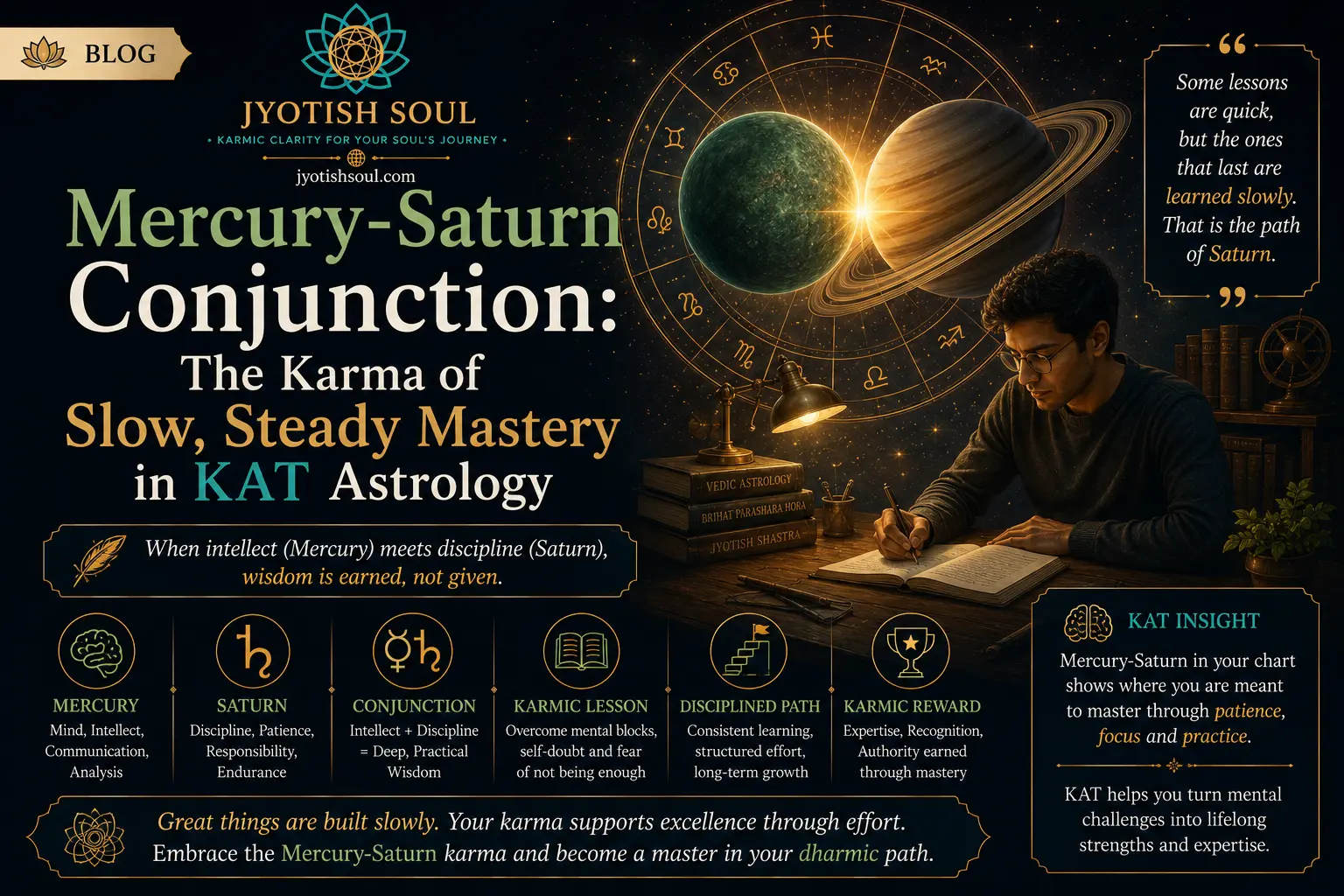

Mercury-Saturn Conjunction: The Karma of Slow, Steady Mastery in KAT Astrology

Spread the love

Mercury moves quickly. It picks up new ideas in an instant and loves variety, conversation, and change. Saturn moves slowly. It builds mastery through repetition, patience, and time.

When these two planets sit together in a birth chart, something interesting happens. Mercury’s quickness meets Saturn’s discipline, and the result is a native who learns deeply, even if it takes longer than expected to get there.

Through KAT (Karma Alignment Technique), this conjunction carries a clear message. True intelligence isn’t about speed. It’s about depth, earned through consistent practice over time.


Mercury and Saturn: Quick Mind, Patient Hand

Mercury governs intelligence, communication, business, and trade. It represents how a person learns, speaks, and connects ideas.

Saturn governs karma, discipline, and the slow, steady pace that builds lasting results. When Saturn touches Mercury, it slows the mind down just enough to turn quick thinking into real mastery.

This combination holds genuine potential for a successful career. But it comes with a particular flavor worth understanding clearly.


The Learning Curve This Conjunction Creates

Natives with this placement may take longer than expected to learn new concepts. This isn’t a lack of intelligence. It’s simply Saturn’s nature, known for its slow and steady gait, asking the mind to absorb things at a different pace than pure Mercury would prefer.

Once the native commits to practicing a concept regularly, though, real command over it follows. The natives may actually be quicker at grasping the subjects that Saturn itself represents, things like structure, systems, and long-term planning.

This is the trade-off at the heart of the conjunction. A bit more patience required upfront, in exchange for knowledge that runs deeper and lasts longer.


Why Business Often Suits This Combination

Mercury is the natural signifier of business and commercial activity. When Saturn joins it, this combination makes the native prefer owning a business over pursuing a traditional job.

Accounting, commissioning, education, and trade all stand out as favorable sectors for these natives. There’s a natural pull toward roles involving structured financial thinking or steady, ongoing client relationships.

These natives also tend to be excellent persuaders. Many become genuinely extraordinary salespeople, combining Mercury’s communication skill with Saturn’s patience and credibility.


What This Reveals About Career Identity

This conjunction often shapes how a person relates to their professional path more broadly. There’s a strong pull toward choosing only the education that will genuinely serve their actual profession, rather than studying broadly without clear direction.

Being a trader, retailer, or commissioner can bring real success here. These natives tend to grasp Saturn’s subject matter quickly once they engage with it, and using their knowledge actively in their work, rather than keeping it theoretical, tends to produce the best results.


The Underlying Karmic Lesson

Every KAT combination teaches something specific about how to work with planetary energy rather than against it. For Mercury-Saturn, the lesson centers on patience with one’s own learning process.

A quick mind can become impatient with anything that doesn’t click immediately. Saturn’s presence here asks for a different relationship with knowledge: trust that mastery comes through repetition, not just initial understanding.

Natives who fight this rhythm, expecting Mercury’s usual speed, often feel frustrated. Natives who accept Saturn’s pace tend to build expertise that genuinely lasts, the kind that doesn’t fade once the initial excitement of learning something new wears off.


A Related Combination Worth Knowing

It’s worth mentioning a closely related pairing here too. When Saturn joins Mercury more broadly across the chart, the causative of karma and results governs the prince, as Mercury is sometimes described in KAT terms.

In this dynamic, these natives should prefer only the education they genuinely wish to apply in their profession, since scattered learning without direction tends to create more friction than focus. Being a trader, retailer, or commissioner often brings strong results, and the native tends to grasp Saturn’s own subject areas with notable speed once properly engaged.


Frequently Asked Questions

Does Mercury-Saturn conjunction mean someone is less intelligent? Not at all. This placement simply changes the pace of learning, not its depth. Many natives with this combination develop expertise that’s more thorough and longer-lasting than faster learners achieve, precisely because Saturn demands real practice rather than surface familiarity.

What careers suit Mercury-Saturn conjunction best? Business ownership, accounting, education, and trade all align well with this placement. The native’s natural pull toward Mercury’s communication skills, combined with Saturn’s discipline, often produces strong results in sales and persuasion-based roles too.

Why might someone with this conjunction struggle in school but succeed in business? Traditional schooling often rewards quick recall, which can feel harder for this placement. Business, on the other hand, rewards sustained practical knowledge built over time, which plays directly to this combination’s strengths.

Is it better to pursue a job or start a business with this placement? KAT suggests this combination naturally favors business ownership over traditional employment, largely because Mercury’s commercial instincts paired with Saturn’s discipline create strong entrepreneurial potential.

How does this conjunction affect communication style? These natives often communicate effectively, particularly in persuasive or sales-oriented contexts. The combination of quick verbal skill and Saturn’s grounded credibility tends to make their words carry real weight with others.


Build Mastery at Your Own Pace

Mercury-Saturn conjunction asks for something many people resist: patience with your own mind. Once embraced, this combination builds a rare kind of expertise, intelligence that has actually been tested and proven through time, not just quick wit alone.

At Jyotish Soul, our KAT consultations help you understand exactly how Mercury and Saturn interact in your own chart, along with practical guidance for your specific career path.

🔮 Ready to understand your Mercury-Saturn karma? Book a KAT Consultation at Jyotish Soul →

Want a written breakdown of this and other key combinations in your chart? Explore Our Karmic PDF Reports →

📖 Continue the KAT series:


Jyotish Soul offers karmic clarity through Vedic astrology, KAT, Parashari, Jaimini, and KP systems. Based in Dhenkanal, Odisha — serving seekers across India and the world.

Mars-Saturn Conjunction: The Karma of Disciplined Action in KAT Astrology

Spread the love

Two very different energies meet when Mars and Saturn sit together in a birth chart. Mars wants to act now. Saturn insists on waiting.

This tension makes the Mars-Saturn conjunction one of the most talked-about placements in Vedic astrology. It can bring real friction. It can also build extraordinary discipline, once understood and worked with consciously.

Through the lens of KAT (Karma Alignment Technique), this conjunction reveals a clear karmic lesson. Action without patience creates chaos. Patience without action creates stagnation. True mastery lies in the middle.


Mars and Saturn: Two Planets, Two Different Speeds

Mars moves fast. It governs courage, confidence, and quick decisive action. Saturn moves slow. It governs karma, discipline, and the long road to earned results.

When these two planets share a sign, their natures collide. The native feels pulled in two directions at once. Part of them wants to act immediately. Another part senses that haste will only create problems.

This is not a flaw in the chart. It’s a built-in lesson about timing.


Why This Conjunction Feels Difficult

This combination carries real challenges, and it helps to name them honestly. The difficulty isn’t because Mars is a natural malefic. It comes from Mars’s deeper signification: grudges, anger, arguments, and tussle.

Natives with this placement often make impulsive decisions in the heat of the moment. Later, they regret the choice. Professional life can also bring roadblocks, often through people working quietly against them behind the scenes.

None of this is fixed, though. Every conjunction carries both challenge and opportunity. The outcome depends heavily on how the energy gets used.


The Career Strength Hidden in This Combination

Despite its challenges, Mars-Saturn natives can build genuinely strong careers. Their natural fit lies in fields that reward both courage and discipline together.

Technical fields suit this placement well. So do defense and army careers, where structured action under pressure is the daily reality. If Jupiter also joins this combination, the native may even excel as a Vastu consultant, blending Mars’s practical energy with Jupiter’s wisdom.

What ties all these paths together is structure. Mars-Saturn natives do best in roles where bold action happens inside a disciplined system, rather than without one.


The Karmic Lesson Underneath

Every KAT combination teaches something specific. For Mars-Saturn, the lesson is timing.

Mars alone says act now. Saturn alone says wait and prepare. Together, they ask the native to learn something most people never master: knowing exactly when to push forward and when to hold back.

Get this wrong, and life delivers regret after regret, each one tied to moving too fast or waiting too long. Get it right, and the native develops a rare kind of strength. Action that is both bold and well-timed.


Practical Remedies for Mars-Saturn Conjunction

KAT offers specific, practical ways to work with this energy rather than fight it.

Sleep on the floor occasionally. This practice helps facilitate Mars’s positive results, grounding its restless energy through simple physical discipline.

Stay physically active. Jogging and regular exercise channel Mars’s drive in a healthy direction, preventing it from building up as frustration or impulsiveness.

Choose a career with built-in structure. Engineering, technical work, and defense-related fields give Mars a productive outlet while honoring Saturn’s need for order.

Notice the conspiracies, but don’t obsess over them. Workplace politics may genuinely arise with this placement. Staying grounded and disciplined, rather than reactive, neutralizes much of their power.

Together, these remedies work toward one goal: balancing and channeling Martian energy so it serves the native instead of working against them.


What This Looks Like in a Female Chart

In a woman’s chart, Mars also represents the husband. When Saturn joins Mars, the indication often points to a hardworking husband, one whose career and effort carry real weight in the relationship.

This adds another layer worth understanding in a full KAT reading, since the conjunction’s effects ripple into partnership dynamics as well as personal career and temperament.


When Mercury Joins the Picture

It’s worth noting a related combination here too. When Mercury joins Mars, education itself can become a source of anxiety for the native, though the person’s sibling often shows strong intellectual ability.

The remedy mirrors the Mars-Saturn approach closely. Physical fitness supports educational success, technical subjects suit the native well, and sports or martial arts help reduce study-related anxiety. The throughline is consistent: Mars energy needs a physical outlet to function at its best.


Frequently Asked Questions

Is Mars-Saturn conjunction always a difficult placement? It brings real friction, particularly around timing and impulsive decisions. But like every KAT combination, the outcome depends on how the energy is used. With the right remedies and career alignment, this placement builds genuine strength.

What careers work best with this conjunction? Technical fields, defense, engineering, and structured action-oriented professions suit this placement well. Adding Jupiter to the mix can open doors toward Vastu consultancy as well.

Why does sleeping on the floor help this combination? This practice is a traditional KAT remedy that grounds Mars’s restless energy, supporting Saturn’s need for stability and helping the native access the conjunction’s positive results.

Does this conjunction affect relationships? In a female chart, this combination often points to a hardworking husband. The discipline and effort theme tends to show up across both career and relationship dynamics.

How is this different from a regular Mars or Saturn placement alone? When these planets conjoin, their energies blend rather than acting separately. The native experiences both Mars’s drive and Saturn’s caution simultaneously, which creates the specific tension and growth opportunity unique to this combination.


Find Your Own Balance Between Action and Patience

Mars-Saturn conjunction asks something difficult of anyone who carries it: learn to act with discipline, and wait with purpose. Master this balance, and the same energy that once caused friction becomes a genuine source of strength.

At Jyotish Soul, our KAT consultations help you see exactly how Mars and Saturn interact in your own chart, along with the specific remedies suited to your placement.

🔮 Ready to understand your Mars-Saturn karma? Book a KAT Consultation at Jyotish Soul →

Want a written breakdown of this and other challenging combinations in your chart? Explore Our Karmic PDF Reports →

📖 Continue the KAT series:


Jyotish Soul offers karmic clarity through Vedic astrology, KAT, Parashari, Jaimini, and KP systems. Based in Dhenkanal, Odisha — serving seekers across India and the world.
How to Align Your Karma: The Practical KAT Method for Real Life Change

Spread the love

Most people think karma is something that simply happens to them. KAT teaches something different.

Karma is a pattern. And every pattern can be worked with. This is the real promise of the Karma Alignment Technique. It does not just explain your struggles. It gives you something to do about them.

In this guide, we move from theory into action. You will learn the actual KAT approach to reading a difficult combination and turning it into a practical, doable remedy.


Karma Is Not a Sentence. It’s a Signal.

KAT starts from a simple but powerful idea. No planetary combination is purely good or bad. Everything depends on how you use it.

A challenging placement is not a punishment. It is a signal. It points to a specific area of life that needs conscious attention. Once you see the signal clearly, you can respond to it instead of just suffering through it.

This is the heart of “alignment.” You are not fighting your chart. You are working with it.


The Three Levels of Karma Alignment

KAT teaches that karma can be aligned at three different levels. Each level offers a different entry point depending on what feels most accessible to you.

House level. If a house is causing trouble, you can work with its themes directly. For example, eighth house struggles often respond well to research-based work. Twelfth house struggles often ease with charity or meditation.

Rashi level. Your zodiac sign placements carry their own instructions. Someone with planets in movable signs benefits from staying flexible and open to movement in life, rather than forcing rigid plans.

Planetary level. This is the most direct and most effective level. Each planet carries specific remedies tied to its nature. This is where most practical KAT work happens.


How a KAT Remedy Actually Works

Every challenging conjunction comes with a matching action. The logic is always the same. You take the planet causing friction, and you consciously feed it something positive through your daily choices.

Let’s walk through a few real examples directly from KAT practice.

Mars-Ketu conjunction. This combination often brings a stubborn, adamant nature and a tendency to delay things. The remedy is movement and service. Regular exercise like jogging or pushups channels the Mars energy. Practicing reiki or another healing art works with Ketu’s detachment in a constructive way.

Mars-Rahu conjunction. This pairing can bring heavy debt, sharp anger, and land-related disputes. The remedy leans into structured physical discipline. Gym training, martial arts, and simply making time to eat at least one meal a day in the kitchen all help ground this volatile combination.

Saturn-Mars conjunction. This often shows up as workplace conflict and quiet conspiracies against the native. The remedy favors a Mars-aligned profession like engineering, along with staying physically active and even sleeping on the floor occasionally to support Saturn’s grounding energy.

Saturn-Rahu conjunction. This brings insecurity and an unclear fear around career. The remedy points toward foreign opportunities, shadow-related fields, and online work, since these align naturally with both planets’ energies.

Saturn-Ketu conjunction. This often creates legal trouble, blockages, and a constant urge to quit one’s work. The remedy is striking. KAT suggests the native study or even practice astrology, healing, law, or medicine, since Ketu’s detachment finds its healthiest outlet in exactly these fields.

Jupiter-Ketu conjunction. This draws someone toward spirituality and occult interests but can create blockages near the finish line of any task. The remedy is daily meditation, regular gardening or writing, and a habit of building plans from the ground up rather than starting from the top.

You can see the pattern. The remedy is never random. It always speaks the same language as the planet involved.


Why Small, Consistent Actions Matter More Than Big Gestures

One thing stands out across every KAT remedy. None of them require dramatic life changes. They ask for small, repeatable actions woven into daily life.

This matters because karma accumulates slowly, and so does its resolution. A single meditation session will not undo a Jupiter-Ketu blockage. A daily meditation practice, sustained over months, genuinely can.

This is why KAT describes itself as something to cultivate like a hobby, not a burden. The shift happens through consistency, not intensity.


A Simple Process to Align Your Own Karma

Here is a straightforward way to begin applying this to your own chart.

Step one. Identify which planet is causing you the most friction right now. Is it career stagnation? Look at Saturn. Is it anxiety or conflict? Look at Mars. Is it confusion or blocked goals? Look at Rahu or Ketu.

Step two. Find what that planet is conjunct with in your chart. The combination tells you the specific flavor of the karma you’re working with.

Step three. Match the combination to its remedy. Each pairing has a natural counterbalance, as shown in the examples above.

Step four. Build the remedy into your routine. Don’t treat it as a one-time fix. Treat it as a practice.

Step five. Watch for shifts over weeks and months, not days. Karma alignment works on its own timeline, not yours.


The Deeper Shift Behind the Technique

Underneath all the specific remedies, KAT is really teaching one core lesson. You are not a passive recipient of your chart. You are an active participant in how it unfolds.

The same Saturn that delays one person’s career becomes another’s source of deep professional credibility, depending entirely on how the energy is used. The same Rahu that brings insecurity to one native becomes the doorway to bold, unconventional success for another.

Nothing about your chart is fixed punishment. It is raw material. What you build with it is still, in large part, up to you.


Frequently Asked Questions

Do I need to do every remedy for every difficult combination in my chart? No. Start with the one or two combinations causing you the most visible difficulty right now. Karma alignment works best with focused, sustained effort rather than scattered attempts at everything at once.

How long before I notice results from a KAT remedy? Most practitioners notice shifts over a period of months rather than days, since these remedies work with deep-seated patterns. Patience and consistency matter more than intensity.

Can KAT remedies replace traditional astrological remedies like gemstones or pujas? KAT remedies work alongside traditional remedies rather than replacing them. Many people find the daily, action-based nature of KAT remedies easier to sustain alongside other spiritual practices.

What if I have several challenging combinations at once? This is common. Prioritize based on which area of life feels most urgent right now, whether that’s career, relationships, or health, and start there.

Is this technique only for people facing problems? Not at all. KAT works just as well for those who want to consciously strengthen already-positive combinations in their chart, not only to fix difficult ones.


Begin Aligning Your Own Karma

Karma Alignment Technique turns astrology from something you watch happen to you into something you actively work with. Every challenging placement carries its own instructions, once you know how to read them.

At Jyotish Soul, our KAT consultations identify the exact combinations shaping your current struggles and walk you through the specific, practical remedies suited to your chart.

🔮 Ready to find your personal alignment practice? Book a KAT Consultation at Jyotish Soul →

Want a written breakdown of your chart’s challenging combinations and remedies? Explore Our Karmic PDF Reports →

📖 Continue the KAT series:


Jyotish Soul offers karmic clarity through Vedic astrology, KAT, Parashari, Jaimini, and KP systems. Based in Dhenkanal, Odisha — serving seekers across India and the world.

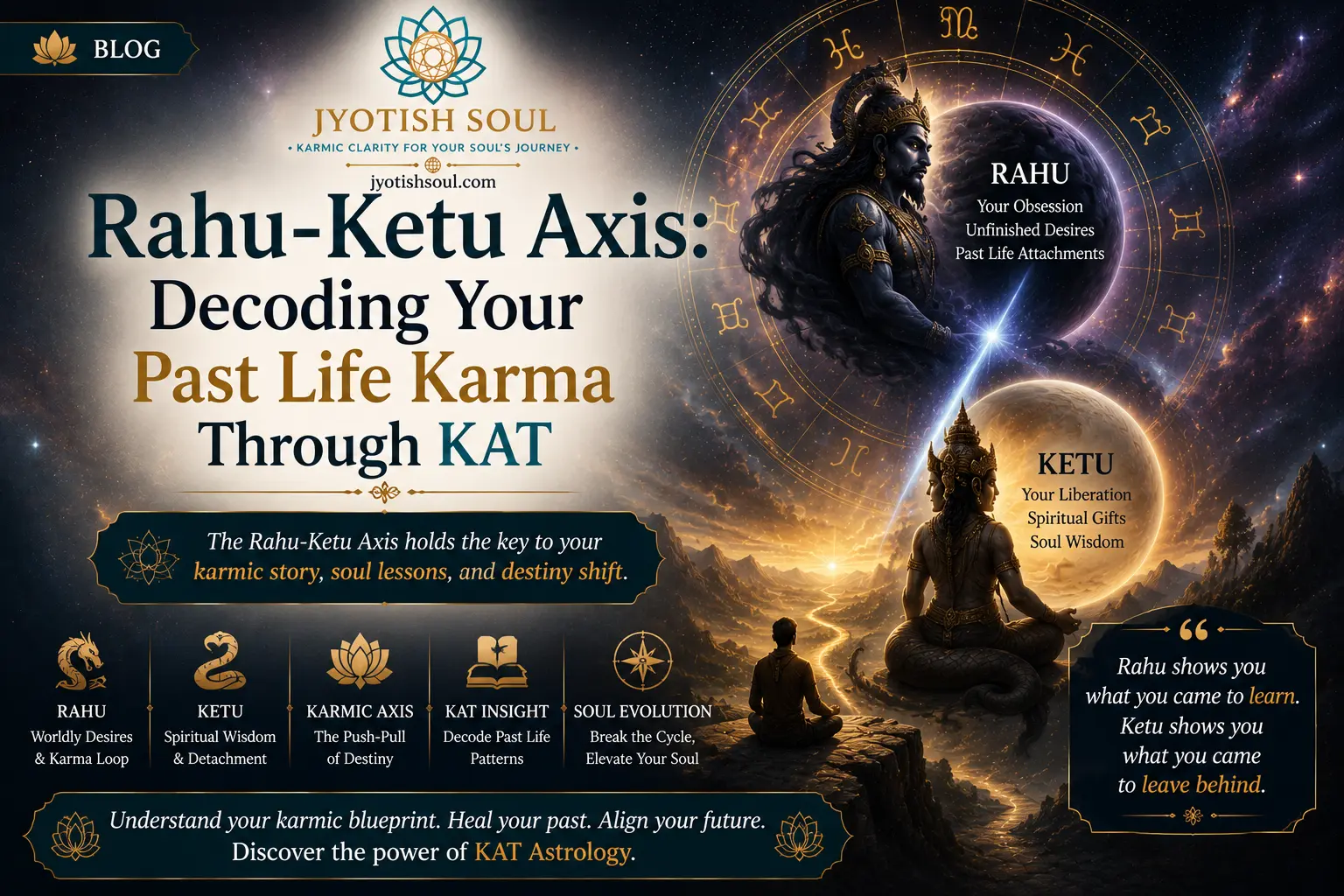
Rahu-Ketu Axis: Decoding Your Past Life Karma Through KAT

Spread the love

Of all the points in a Vedic birth chart, none carry quite the mystique — or the karmic weight — of the Rahu-Ketu axis.

Unlike the seven classical planets that you can see in the sky, Rahu and Ketu are shadow points — the lunar nodes, mathematical points where the Moon’s orbit intersects the Sun’s apparent path. You cannot see them. You cannot touch them. And yet, in Vedic astrology, they are considered among the most powerful indicators of karma carried forward from past lives.

In our KAT series so far, we have explored Saturn’s conjunctions and the foundational principles of Bhrigu Nandi Nadi. Now we turn to perhaps the most profound karmic axis of all — the one that reveals not just what your karma is, but where it came from and where it is taking you.


What Are Rahu and Ketu?

In Vedic astrology, Rahu (the North Node) and Ketu (the South Node) are always positioned exactly opposite each other in the zodiac — 180 degrees apart. They move together as a single karmic axis, never separating.

Rahu — The Head of the Shadow

Rahu represents:

  • Worldly desire, ambition, and material pursuit
  • The unknown, the foreign, and the unconventional
  • Obsession, illusion, and insatiable hunger
  • Sudden, unexpected events and transformation
  • Future-oriented karma — what the soul is moving toward

Ketu — The Tail of the Shadow

Ketu represents:

  • Past life mastery and accumulated spiritual wisdom
  • Detachment, renunciation, and moksha (liberation)
  • Loss, isolation, and the dissolving of what no longer serves
  • Intuition, mysticism, and hidden knowledge
  • Past-oriented karma — what the soul is releasing

The Karmic Story Told by the Rahu-Ketu Axis

In KAT, the Rahu-Ketu axis is read as a single, unified karmic narrative — not two separate, unrelated points, but one continuous karmic journey with two ends.

Ketu shows you where you have already mastered something — skills, wisdom, or experiences carried forward from past lives. Rahu shows you where your soul is now being pulled to grow — often into territory that feels unfamiliar, uncomfortable, or even frightening.

This is one of the most beautiful and practical teachings in Vedic astrology: your greatest growth in this lifetime lies in the direction of Rahu, but your innate gifts and foundation lie in the house and sign of Ketu.

Think of it this way: Ketu is the launchpad. Rahu is the destination. The soul’s journey in this incarnation is to use the mastery of Ketu as a foundation while courageously moving toward the unfamiliar growth that Rahu demands.


Why the Rahu-Ketu Axis Feels Uncomfortable

Almost everyone who studies their own Rahu-Ketu placement notices something: the house and sign where Rahu sits often represents an area of life that feels confusing, intensely desired, yet strangely unsatisfying no matter how much is achieved there. Meanwhile, the house and sign where Ketu sits often feels easy, almost too easy — sometimes to the point of boredom or a tendency to abandon that area prematurely.

This is not a flaw in the chart. It is the precise mechanism of karmic growth.

Ketu’s domain feels easy because the soul has already mastered it in previous incarnations. There is no real growth left there — only the temptation to stay in a zone of comfort and old identity.

Rahu’s domain feels difficult and obsessive because the soul has little to no prior experience there. It is genuinely new territory — exciting, magnetic, but also disorienting, because the soul has not yet built the skills or confidence that come naturally in Ketu’s domain.

KAT teaches that true alignment comes from honouring both ends of this axis — not abandoning Ketu’s gifts, but also not avoiding Rahu’s call to grow.


The Rahu-Ketu Axis and Saturn: A Powerful KAT Combination

Earlier in this series, we explored how Saturn — the Karma Karaka — reveals karmic themes through its conjunctions with other planets. The Rahu-Ketu axis adds another profound layer when it interacts with Saturn specifically.

Saturn Conjunct Rahu

When Saturn and Rahu conjoin, the karmic theme becomes one of intense, transformative ambition combined with karmic restructuring. This placement often indicates:

  • A soul that is karmically driven to break old systems and build something entirely new
  • Significant life disruptions that, while painful, clear the way for major transformation
  • Themes of foreign lands, unconventional careers, or industries that did not exist in previous generations
  • A tendency toward obsessive ambition that must be tempered with Saturn’s discipline and ethics

This combination, when aligned, often produces innovators, entrepreneurs, and those who reshape entire systems or industries — but the karmic lesson is always about channeling ambition through integrity rather than desperation.

Saturn Conjunct Ketu

When Saturn and Ketu conjoin, the karmic theme shifts toward deep detachment combined with spiritual or specialised mastery. This placement often indicates:

  • Significant past-life expertise in a specific field, now being applied with humility in this lifetime
  • A tendency toward isolation, introspection, and a sense of being “different” from peers
  • Themes of loss or letting go that ultimately lead to spiritual depth
  • A natural inclination toward research, healing, astrology, or behind-the-scenes work

This combination often produces healers, researchers, and spiritual practitioners — souls who carry old wisdom and are learning to apply it with detachment from worldly recognition.


The Rahu-Ketu Axis Through the Houses

While a complete analysis depends on your unique chart, here is a general overview of how the Rahu-Ketu axis expresses across the houses — useful for beginning to understand your own karmic direction.

1st-7th House Axis Karma around self versus partnership. Rahu in the 7th pulls toward relationships and partnership as the growth edge; Ketu in the 1st suggests past-life mastery of independence and self-reliance.

2nd-8th House Axis Karma around material values versus transformation. Rahu in the 8th draws the soul toward deep transformation, occult knowledge, and shared resources; Ketu in the 2nd suggests past mastery of values, family, and accumulated resources.

3rd-9th House Axis Karma around courage and effort versus higher wisdom. Rahu in the 9th pulls toward philosophy, higher learning, and expansive belief systems; Ketu in the 3rd suggests past mastery of communication, effort, and skill.

4th-10th House Axis Karma around emotional roots versus public career. Rahu in the 10th drives intense career ambition and public recognition; Ketu in the 4th suggests past mastery of home, emotional security, and inner foundations.

5th-11th House Axis Karma around creative self-expression versus social gain. Rahu in the 11th pulls toward networks, gains, and large-scale ambitions; Ketu in the 5th suggests past mastery of creativity, intelligence, and personal romance.

6th-12th House Axis Karma around service and struggle versus surrender and liberation. Rahu in the 12th draws the soul toward spiritual surrender, foreign connections, and loss of ego boundaries; Ketu in the 6th suggests past mastery of service, health discipline, and overcoming obstacles.

(Note: Rahu and Ketu axis positions mirror each other across all six house-pairs above — if Rahu is in one house of a pair, Ketu is automatically in the opposite house.)


Past Life Karma: What KAT Says About Where You’ve Been

One of the most common questions seekers bring to a KAT consultation is some version of: “What was I in my past life? What karma am I carrying?”

While KAT does not claim to provide literal, specific past-life biographical detail (no astrological system can verify this with certainty), it does offer something deeply useful: a clear map of the skills, tendencies, and unresolved patterns your soul carries forward.

Ketu’s house and sign, along with any planets conjunct with Ketu, reveal:

  • Skills and talents that come unusually easily to you, almost as if you already knew them
  • Areas of life where you may feel a strange sense of “been here before” déjà vu
  • Patterns of detachment or loss that repeat until the underlying lesson is integrated
  • Spiritual gifts — particularly when Ketu conjoins planets like Jupiter, Mercury, or the Moon

Meanwhile, Rahu’s house, sign, and conjunct planets reveal:

  • The specific growth edge your soul has chosen for this incarnation
  • Areas of intense, sometimes obsessive desire that point to unresolved karmic hunger
  • The “homework” of this lifetime — skills and experiences your soul has not yet mastered
  • Where sudden, unexpected, transformative events are most likely to occur

How to Align with Your Rahu-Ketu Karma

KAT emphasises that the Rahu-Ketu axis, more than perhaps any other karmic indicator, requires conscious balance. Here is how to begin aligning with this powerful axis:

1. Honour your Ketu gifts without overstaying Use the skills and wisdom that come easily to you (Ketu) as a foundation — but do not let comfort there become an excuse to avoid growth.

2. Move toward Rahu consciously, not compulsively Rahu’s pull can feel obsessive and ungrounded. The alignment is to pursue Rahu’s growth area with intention and ethics, rather than blind hunger or desperation.

3. Watch for extremes Both Rahu and Ketu can manifest in extreme ways when unintegrated — Rahu through excess, obsession, or illusion; Ketu through excessive withdrawal, isolation, or escapism. Awareness of this tendency is the first step to balance.

4. Use Ketu’s detachment to support Rahu’s ambition Paradoxically, the wisdom of detachment (Ketu) often makes Rahu’s pursuits more successful. When you chase your Rahu-driven goals without desperate attachment to the outcome, you tend to move toward them with far greater ease and grace.

5. Recognise the spiritual purpose of the axis Ultimately, the Rahu-Ketu axis exists to push the soul beyond comfort and toward growth — and eventually, toward the realisation that lasting peace cannot be found at either extreme, but in the integration of both energies.


Frequently Asked Questions

Q: Why don’t Rahu and Ketu have physical forms like other planets? Rahu and Ketu are mathematical points (the lunar nodes) rather than physical celestial bodies. In Vedic astrology, they are still treated as powerful karmic forces — sometimes called “shadow planets” — because of the profound influence they exert through eclipses and karmic patterning.

Q: Can the Rahu-Ketu axis change over a person’s lifetime? The natal Rahu-Ketu axis is fixed at birth and does not change. However, transiting Rahu and Ketu move through the zodiac (taking about 18 months to cross each sign) and activate different karmic themes as they transit through your chart over time.

Q: Is it bad to have Rahu or Ketu in a particular house? In KAT, no house placement of Rahu-Ketu is inherently “bad.” Each placement carries its own karmic curriculum — some more challenging in worldly terms, others more challenging in spiritual terms. The key is understanding and consciously working with whatever placement you have.

Q: How does the Rahu-Ketu axis relate to Saturn in KAT specifically? Since Saturn is the Karma Karaka in KAT, its relationship with the Rahu-Ketu axis (through conjunction or aspect) adds significant depth to understanding how karma from past patterns intersects with present-life discipline and effort. We explored this in detail earlier in this blog.

Q: Should I be afraid of my Rahu placement since it represents “unknown” territory? Not at all. While Rahu’s territory is unfamiliar, it represents your soul’s chosen direction for growth in this lifetime. Fear of it usually indicates exactly where the most meaningful expansion is waiting for you.


Discover Your Karmic Direction

The Rahu-Ketu axis is one of the most profound tools for understanding your soul’s journey — where you have been, what you have mastered, and where you are now being called to grow. Within the KAT framework, this axis becomes a practical map for conscious living rather than a source of fear or confusion.

At Jyotish Soul, our KAT consultations help you understand your unique Rahu-Ketu placement and how it interacts with Saturn and other key planets in your chart — giving you genuine clarity on your karmic direction.

🔮 Ready to decode your past life karma and soul direction? Book a KAT Consultation at Jyotish Soul →

Want a written analysis of your Rahu-Ketu axis to study at your own pace? Explore Our Karmic PDF Reports →

📖 Continue the KAT series:


Jyotish Soul offers karmic clarity through Vedic astrology, KAT, Parashari, Jaimini, and KP systems. Based in Dhenkanal, Odisha — serving seekers across India and the world.
How Bhrigu Nandi Nadi Forms the Foundation of KAT Astrology

Spread the love

Every powerful system has a foundation — a root from which everything else grows. For the Karma Alignment Technique (KAT), that foundation is an ancient and profound branch of Vedic astrology called Bhrigu Nandi Nadi, commonly known as BNN.

If you have followed our KAT series so far, you have seen how Saturn’s conjunctions reveal career karma, how Jupiter-Saturn creates the Guru-Karma Code, and how Sun-Saturn builds an unbreakable soul through struggle. But you may be wondering — where do these principles come from? Why does KAT focus so heavily on planetary conjunctions rather than the house-and-lord system most people associate with Vedic astrology?

The answer lies in BNN — and understanding it will deepen your appreciation for everything KAT teaches.


What Is Bhrigu Nandi Nadi?

Bhrigu Nandi Nadi is one of the classical Nadi astrology texts within the vast ocean of Vedic astrological literature. Nadi astrology itself is an ancient predictive tradition, traditionally attributed to sage Bhrigu and preserved across generations of practitioners in India.

While many Nadi texts exist — each with its own focus and methodology — Bhrigu Nandi Nadi is distinguished by a particular approach: it places planetary conjunctions and relationships at the very centre of chart interpretation, rather than relying primarily on house lordships, as is common in mainstream Parashari astrology.

This is the single most important thing to understand about BNN: it is planet-centric, not house-centric.


The Core Philosophy: Planets as Living Karmic Forces

To understand why BNN works the way it does, we need to shift how we think about planets in a birth chart.

In conventional Vedic astrology, much of the analysis revolves around questions like: Which house does this planet rule? Which house is it placed in? What aspects affect that house?

BNN takes a different starting point. It asks: What is this planet’s inherent karmic nature — and which other planets is it interacting with?

In BNN philosophy, every planet carries an inherent significance — what is called its karakatwa (natural signification). The Sun signifies soul and authority. The Moon signifies mind and emotion. Mars signifies action and courage. And so on.

But a planet rarely acts alone. Just as a person’s behaviour is shaped by the company they keep, a planet’s expression in your life is profoundly shaped by which other planets it associates with — particularly through conjunction (planets sharing the same sign).

In BNN, planetary conjunction is the primary language through which karma speaks.

This is precisely the principle that KAT inherits and builds upon — which is why, in our earlier blogs, we focused so heavily on Saturn’s conjunctions with Jupiter, Sun, Mars, Mercury, Venus, Rahu, and Ketu to decode different dimensions of karma.


The Traveller Metaphor: Understanding Planetary Conjunction in BNN

One of the most beautiful teachings in BNN uses the metaphor of a traveller on a journey to explain how planetary conjunction works.

Imagine a planet as a traveller moving through the zodiac. As this traveller moves from sign to sign, it occasionally meets other travellers (planets) who happen to be in the same place (sign) at the same time.

When two travellers meet, they exchange stories, influence each other’s mood, and sometimes even change each other’s plans. The Sun-traveller meeting the Saturn-traveller might emerge a little more serious, a little more burdened, but also wiser and more disciplined. The Jupiter-traveller meeting the Saturn-traveller might emerge committed to a more patient, structured path toward wisdom.

This is exactly how BNN — and by extension, KAT — interprets conjunctions. The planets are not static positions. They are dynamic karmic forces that absorb and transmit energy through their relationships with one another.


The Significance of the Rasi Chart in BNN

In BNN, the Rasi chart (the basic birth chart showing planetary placements by sign) takes on heightened importance compared to some other Vedic systems that lean more heavily on divisional charts (varga charts) for specific life areas.

This does not mean BNN ignores divisional charts — they remain valuable tools. But the primary karmic story is read directly from the Rasi chart, through:

  1. Sign placement of each planet — providing the basic flavour of how that planet’s energy expresses
  2. Conjunctions — which other planets share the same sign
  3. The 1-5-9 trine axis — special relationships between signs that form a triangular pattern
  4. Aspectual relationships — though secondary to conjunction in BNN’s framework

This relative simplicity is part of what makes BNN — and KAT — so powerful and accessible. You do not need to calculate dozens of divisional charts to begin understanding your core karmic patterns. The Rasi chart, read through the lens of planetary conjunction, already tells a remarkably clear story.


The 1-5-9 Trine Axis: A Key BNN Principle

One of the most important structural principles in BNN is the 1-5-9 trine axis — also called the Trikona (triangle) relationship.

In Vedic astrology, houses 1, 5, and 9 form a trine relationship — they are considered to share a deep, harmonious resonance with one another. In BNN, this trine relationship extends to signs as well: signs that are in 1-5-9 relationship to each other (i.e., 4 signs apart) share a special karmic bond.

For example: Aries, Leo, and Sagittarius form one trine axis. Taurus, Virgo, and Capricorn form another. Gemini, Libra, and Aquarius form a third. Cancer, Scorpio, and Pisces form the fourth.

In BNN-based reading, when planets occupy signs along the same trine axis — even without being in exact conjunction — they share karmic resonance and influence each other’s expression. This is one of the more advanced layers of BNN analysis, and it adds significant depth to understanding how seemingly separate planets in your chart are actually karmically connected.


Why BNN Resonates So Deeply with Karma-Focused Astrology

BNN’s planet-centric, conjunction-based approach is particularly well-suited to questions of karma for a specific reason: karma, by its very nature, is relational.

Karma is not created in isolation. It is created through interaction — your actions toward others, your relationships, your conjunctions with other souls and circumstances. It makes profound sense, then, that a system designed to reveal karmic patterns would focus on planetary interactions (conjunctions) rather than static positional placements alone.

This is the deep wisdom embedded in BNN that Rahul Kaushik Sir has brought forward through the Karma Alignment Technique — taking a classical, sometimes complex Nadi text and translating its core principles into a practical, accessible framework that modern seekers can understand and apply to their own karmic journey.


How BNN Differs from Parashari Astrology — A Quick Comparison

Aspect Parashari Astrology BNN / KAT Approach
Primary focus House lordships and placements Planetary conjunctions and karakatwa
Chart emphasis Multiple divisional charts (vargas) Primarily the Rasi chart
Reading style “Which house does this planet rule and where is it placed?” “What is this planet’s nature, and who does it associate with?”
Karma interpretation Inferred through house significations Directly read through planetary relationships
Complexity for beginners Requires extensive memorisation of house rules More intuitive once core planetary natures are understood

It is worth emphasising: these systems are not in competition. Many skilled astrologers, including those at Jyotish Soul, use both Parashari and BNN/KAT principles together, allowing each system’s strengths to illuminate different dimensions of a person’s chart and karma.


A Living Tradition: BNN in the Modern Era

While Bhrigu Nandi Nadi has ancient roots, its application today — particularly through frameworks like KAT — represents a living, evolving tradition. Rahul Kaushik Sir’s contribution through Jyotish Vedang has been to take BNN’s classical principles and structure them into a method that is teachable, learnable, and directly applicable to the questions modern seekers bring: career confusion, relationship patterns, health concerns, and the deeper search for life purpose.

This is the beauty of Vedic astrology as a living science — ancient wisdom, continuously refined and made accessible for each generation that seeks its guidance.


Frequently Asked Questions

Q: Is Bhrigu Nandi Nadi the same as other Nadi systems like Chandra Kala Nadi? No. While both are part of the broader Nadi astrology tradition and share some philosophical roots, Bhrigu Nandi Nadi has its own distinct methodology, particularly its strong emphasis on planetary conjunctions in the Rasi chart. Each Nadi text has its own character and areas of strength.

Q: Do I need a Nadi-style “thumb impression” reading to use BNN principles? No — that practice belongs to a different, separate tradition within Nadi astrology (Nadi leaf reading, primarily associated with South Indian palm-leaf manuscripts). BNN, as used in KAT, works directly with your standard Vedic birth chart calculated from birth date, time, and place.

Q: Can BNN principles be combined with Western astrology? While BNN is rooted specifically in the Vedic (sidereal) zodiac system, its core principle — that planetary conjunctions reveal combined significations — is a universal astrological truth that resonates across traditions. However, for accurate KAT-based readings, we recommend working within the Vedic sidereal framework, as that is the system within which BNN’s classical wisdom was developed.

Q: How accurate is BNN compared to other astrological systems? No single system holds a monopoly on astrological truth. BNN’s strength lies in its clarity around karmic and conjunction-based patterns. Many practitioners, including at Jyotish Soul, find that combining BNN/KAT insights with Parashari analysis provides the most complete and nuanced understanding of a chart.

Q: Why haven’t I heard of BNN before if it’s so insightful? Bhrigu Nandi Nadi has historically been a more specialised tradition within Vedic astrology, often transmitted through specific lineages of teachers and students rather than widely popularised. Rahul Kaushik Sir’s work through Jyotish Vedang and the KAT framework has played a significant role in making these principles more accessible to English-speaking audiences worldwide.


Go Deeper Into Your Karmic Blueprint

Understanding Bhrigu Nandi Nadi gives you the “why” behind everything we have explored in this KAT series — why Saturn’s conjunctions reveal career karma, why Jupiter-Saturn creates the Guru-Karma Code, and why Sun-Saturn builds resilience through struggle. It is all rooted in this elegant, conjunction-based wisdom tradition.

At Jyotish Soul, our KAT consultations apply these BNN principles directly to your unique birth chart — revealing the karmic patterns that shape your career, relationships, health, and spiritual path.

🔮 Ready for a BNN-based karmic reading of your own chart? Book a KAT Consultation at Jyotish Soul →

Prefer a written analysis you can study at your own pace? Explore Our Karmic PDF Reports →

📖 Continue the KAT series:


Jyotish Soul offers karmic clarity through Vedic astrology, KAT, Parashari, Jaimini, and KP systems. Based in Dhenkanal, Odisha — serving seekers across India and the world.
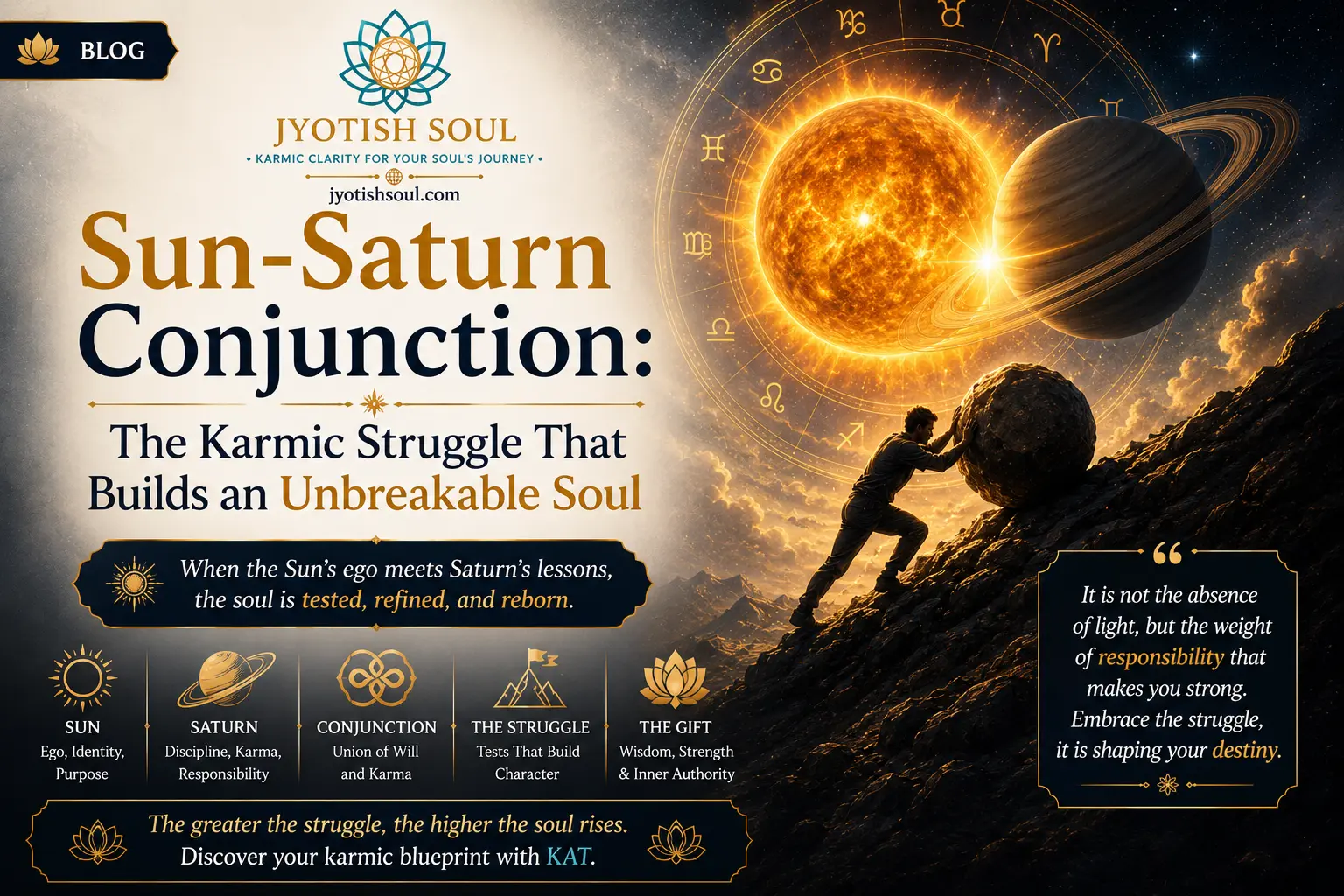
Sun-Saturn Conjunction: The Karmic Struggle That Builds an Unbreakable Soul

Spread the love

There is a moment in almost every Sun-Saturn native’s life when they ask the universe a raw, exhausted question:

“Why is everything so much harder for me than for others?”

The career that should have taken off — delayed. The recognition that was deserved — withheld. The relationship with the father or authority figures — complicated, painful, or absent. The sense of self — constantly tested, questioned, refined.

If you have the Sun and Saturn conjunct in your birth chart, you carry one of the most demanding — and ultimately one of the most powerful — karmic signatures in Vedic astrology.

Through the lens of the Karma Alignment Technique (KAT), developed by Rahul Kaushik Sir of Jyotish Vedang, this conjunction is not a curse. It is a karmic forge — and the soul that passes through it emerges as something extraordinary.


Sun and Saturn: Two Planets in Deep Karmic Tension

To understand the Sun-Saturn conjunction, we must first understand why these two planets are considered natural enemies in Vedic astrology — and what that means for your karma.

The Sun — Soul, Identity, and Authority

In KAT, the Sun represents:

  • The soul and its core identity
  • Self-expression, confidence, and personal power
  • Father, authority figures, and the relationship with hierarchy
  • Leadership, recognition, and public standing
  • Vitality, light, and the conscious self
  • Government, administration, and positions of power

The Sun is who you are at your deepest level. It is your light, your will, your sense of self-worth. When the Sun shines freely, a person radiates confidence, commands natural authority, and moves through life with a sense of inherent dignity.

Saturn — Karma, Discipline, and the Great Tester

In KAT, Saturn represents:

  • Karma — the accumulated weight of past actions
  • Discipline, restriction, and hard-earned lessons
  • Delay, obstacles, and the slow path
  • Service, humility, and detachment from ego
  • The common masses and themes of justice
  • Longevity built through sustained effort

Saturn is the planet that tests. It does not care about your feelings or your preferences. It cares only about your karma — and it will create exactly the experiences needed to burn away what is false and strengthen what is real.


When Sun Meets Saturn: The Karmic Collision

When these two opposing energies conjoin in your birth chart, the result is a profound karmic tension that plays out across your entire life.

The Sun wants to shine — freely, brightly, confidently. Saturn says: “Not yet. Earn it first.”

The Sun wants recognition and authority. Saturn says: “Prove yourself. Again and again.”

The Sun wants a strong, supportive relationship with the father and authority figures. Saturn says: “That relationship will be your greatest karmic lesson.”

This is the essence of the Sun-Saturn karmic code in KAT:

Your identity, confidence, and authority were not freely given to you in this lifetime. They are your karmic assignment — things you must build, earn, and claim through discipline, perseverance, and the willingness to keep going when everything tells you to stop.


The Three Core Karmic Themes of Sun-Saturn Conjunction

In KAT, the Sun-Saturn conjunction consistently manifests through three major karmic themes. Understanding these helps you see your own life patterns with clarity and compassion.

1. The Father Karma

The Sun rules the father in Vedic astrology. Saturn rules karma, restriction, and difficult lessons. When they conjoin, the relationship with the father becomes one of the central karmic arenas of this lifetime.

Sun-Saturn natives commonly experience:

  • An absent, distant, or emotionally unavailable father
  • A father who is strict, authoritarian, or difficult to please
  • Loss of the father early in life — through death, separation, or estrangement
  • A father who is himself burdened by struggle, illness, or hardship
  • Deep longing for paternal approval that feels perpetually out of reach

This is not random. In KAT, this pattern points to unresolved karma between the soul and the paternal lineage — karma that this lifetime is specifically designed to heal and complete.

The karmic healing comes when the Sun-Saturn native stops seeking the father’s approval and instead becomes their own source of authority and self-validation. When you become the father you needed — for yourself, and perhaps for your own children — the Sun-Saturn karma begins to resolve.

2. The Authority and Recognition Karma

The Sun rules recognition, leadership, and public standing. Saturn delays, restricts, and tests. Together, they create a lifelong pattern around earning authority the hard way.

Sun-Saturn natives are rarely handed positions of leadership or public recognition early in life. They often watch peers advance more quickly, feel overlooked despite genuine merit, and struggle with systems or institutions that seem to work against them.

But here is what KAT reveals about this pattern:

Saturn is not blocking your success. Saturn is building your credibility.

The authority that Sun-Saturn natives eventually earn is qualitatively different from authority that comes easily. It is unshakeable — built on real experience, genuine resilience, and tested character. When a Sun-Saturn native finally steps into their authority, no one can take it away. It is carved from the stone of lived experience.

3. The Self-Worth and Identity Karma

Perhaps the deepest karmic theme of the Sun-Saturn conjunction is internal — the ongoing battle between the soul’s inherent worth (Sun) and the karmic weight of self-doubt (Saturn).

Sun-Saturn natives often carry a quiet but persistent inner critic — a voice that says:

  • “You are not good enough yet.”
  • “You need to work harder before you deserve recognition.”
  • “Who are you to lead, to teach, to be seen?”

This is Saturn doing its inner work. It is dismantling ego-based identity — the false self that seeks validation from outside — and slowly, painfully, building something far more valuable: genuine self-worth rooted in integrity and effort rather than external approval.

The karmic journey is complete when the Sun-Saturn native no longer needs the world to confirm their worth. When they know, deeply and quietly, that they are enough — not because they have achieved everything, but because they have become someone of genuine substance.


The Gift Hidden in the Struggle

KAT teaches us that every karmic pattern contains both a wound and a gift. The Sun-Saturn conjunction is no exception.

Here are the extraordinary gifts that Sun-Saturn karma develops — gifts that souls with easier placements rarely possess:

Unshakeable resilience — Sun-Saturn natives have been tested so thoroughly that very little can truly break them. They have a quiet, unannounced strength that others sense and are drawn to.

Authentic authority — When they finally step into leadership, it is real. It is not performance. It is not inherited. It is earned — and people can feel the difference.

Deep empathy for struggle — Having faced their own battles with recognition, confidence, and identity, Sun-Saturn natives carry a profound understanding of others who are going through similar karmic tests. This makes them exceptional mentors, guides, and counsellors.

Integrity under pressure — Saturn demands that the Sun shine honestly, not performatively. Sun-Saturn natives, when aligned, possess a rare integrity — they will not compromise their values for applause or approval.

Longevity of achievement — What Sun-Saturn natives build lasts. Because it was built slowly, carefully, and on solid karmic foundations, their legacy endures long after quick-rise natives have faded.


Sun-Saturn Conjunction Across Signs

The sign in which Sun and Saturn conjoin shapes how the karmic themes express:

  • Aries — Karma around leadership and courage; must earn the right to lead through action, not just ambition
  • Taurus — Karma around material security and self-worth; building wealth and stability through patient effort
  • Gemini — Karma around communication and intellectual recognition; the writer or speaker whose voice takes time to be heard
  • Cancer — Deep emotional and family karma; healing the mother-father dynamic and finding inner security
  • Leo — The most intense Sun-Saturn expression; the karma of ego dissolution and authentic self-expression
  • Virgo — Karma around service and perfectionism; learning that effort has inherent value regardless of perfection
  • Libra — Karma around relationships and justice; the slow building of genuine partnership and fair authority
  • Scorpio — Deep transformation karma; authority earned through navigating darkness and emerging intact
  • Sagittarius — Karma around belief and philosophy; the teacher who must first unlearn before they can truly know
  • Capricorn — Saturn’s own sign amplifies the karmic themes; extraordinary potential for earned worldly authority
  • Aquarius — Karma around social contribution; leadership in service of the collective
  • Pisces — Spiritual karma; the dissolution of ego-identity in service of something greater than the self

Karmic Professions for Sun-Saturn Conjunction

In KAT, the Sun-Saturn conjunction consistently draws natives toward professions where authority is earned through long service and genuine expertise:

  • Government administration and civil services
  • Law, judiciary, and public policy
  • Medicine — especially long-specialisation fields like surgery
  • Corporate leadership built over decades
  • Politics and public service
  • Spiritual leadership earned through genuine sadhana
  • Military or disciplinary services
  • Historical research, archaeology — professions that deal with the weight of time

Common thread across all these: none of them offer quick recognition. All require years of dedicated service before authority is granted. This is the Sun-Saturn native’s natural karmic habitat.


Periods When Sun-Saturn Karma Activates Most Strongly

In KAT, certain astrological periods bring the Sun-Saturn themes to the forefront:

Saturn Mahadasha — A 19-year period during which Saturn’s lessons dominate. For Sun-Saturn natives, this is often the most intense karmic testing period — but also the most transformative.

Sade Sati — The 7.5-year period when Saturn transits over the natal Moon. For Sun-Saturn natives, this period often brings career restructuring, identity shifts, and deep inner work around self-worth.

Sun-Saturn transit contacts — When transiting Saturn conjuncts, squares, or opposes the natal Sun, or when transiting Sun contacts natal Saturn, the karmic themes activate in specific, focused ways.

Understanding these timing cycles is a core part of KAT — knowing when your karma is activating helps you work with it consciously rather than being overwhelmed by it.


How to Align Your Sun-Saturn Karma

KAT is not just about reading karma — it is about aligning with it. Here are the alignment practices most relevant for Sun-Saturn natives:

1. Stop fighting the pace Saturn will not be rushed. The sooner you accept that your path requires more time and more effort than others’, the sooner you stop suffering about it and start building with it.

2. Build your own inner authority Stop waiting for external validation — from your father, your boss, your peers, your audience. Begin treating your own judgment, your own effort, and your own values as the primary standard. This is the Sun reclaiming its light from Saturn’s shadow.

3. Dedicate yourself to one path with consistent effort Saturn rewards those who show up, day after day, without drama. Pick your dharmic path and walk it with quiet, sustained dedication. The recognition will come — in Saturn’s time, not yours.

4. Heal the father relationship consciously Whether your father is present or absent, living or passed, the karmic healing requires conscious engagement. Therapy, forgiveness work, ancestral healing practices, or simply writing about your experience — Saturn rewards those who face this karma rather than suppress it.

5. Embrace Saturn’s remedies Serving those less fortunate, working with discipline and humility, honouring elders and authority figures with respect (not resentment) — these are Saturn’s alignment practices that directly ease the Sun-Saturn karmic tension.


Frequently Asked Questions

Q: Is Sun-Saturn conjunction always difficult? The conjunction brings significant karmic challenges, particularly in the first half of life. However, KAT views these not as misfortune but as a specific karmic curriculum. The second half of life — when Saturn’s lessons have been genuinely absorbed — often brings remarkable authority, achievement, and inner peace.

Q: I have Sun-Saturn conjunction and a difficult relationship with my father. Can astrology help me understand this? Yes — this is one of the clearest expressions of Sun-Saturn karma. A KAT consultation can help you understand the deeper karmic story behind this relationship and what healing or completion looks like for your specific chart.

Q: Does Sun-Saturn conjunction always delay career success? Delay is common, especially in the early years. However, what Sun-Saturn builds tends to be enduring. Many natives with this conjunction reach their peak achievements in their 40s and 50s — later than average, but far more substantial.

Q: Can Sun-Saturn conjunction indicate problems with government or authority? It can indicate friction with authority systems — bosses, institutions, government. This is part of the karmic pattern. However, when aligned, Sun-Saturn natives often become respected figures within these very systems. The friction becomes fuel for genuine reform and leadership.

Q: How does Sun-Saturn conjunction affect self-confidence? This is one of its most direct impacts — chronic self-doubt and a tendency to undervalue oneself. KAT-based guidance helps Sun-Saturn natives understand why this pattern exists karmically and how to consciously rebuild authentic self-worth.


You Were Not Made to Shine Easily — You Were Made to Shine Lastingly

The Sun-Saturn conjunction does not produce quick stars. It produces enduring lights — souls whose brilliance is real because it was forged in difficulty, tested in the fire of karmic challenge, and refined into something that cannot be extinguished.

If you carry this conjunction, you are not behind. You are not broken. You are being built.

At Jyotish Soul, our KAT-based consultations help Sun-Saturn natives understand exactly where they are in their karmic journey — and what specific steps will move them from struggle into alignment, from self-doubt into genuine authority.

🔮 Ready to understand your Sun-Saturn karma? Book a KAT Consultation at Jyotish Soul →

Want a written deep-dive into your Sun-Saturn placement and what it means for your life path? Explore Our Karmic PDF Reports →

📖 Continue the KAT series:


Jyotish Soul offers karmic clarity through Vedic astrology, KAT, Parashari, Jaimini, and KP systems. Based in Dhenkanal, Odisha — serving seekers across India and the world.

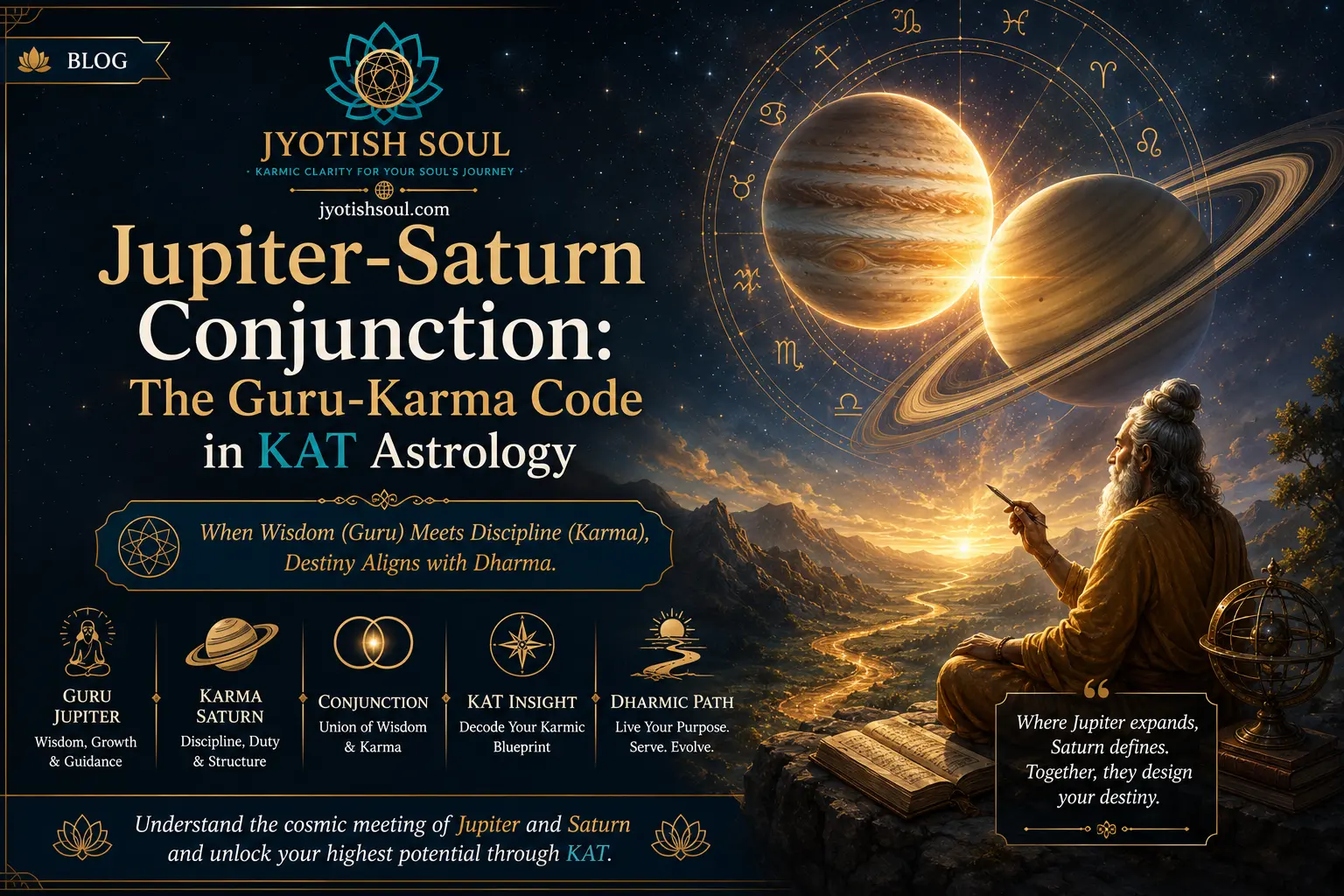
Jupiter-Saturn Conjunction: The Guru-Karma Code in KAT Astrology

Spread the love

Of all the planetary conjunctions that astrology speaks of, few carry the weight and depth of Jupiter conjunct Saturn.

In Vedic astrology, Jupiter and Saturn are often described as opposing forces — Jupiter expands, Saturn contracts. Jupiter blesses, Saturn tests. Jupiter gives faith, Saturn demands discipline. And yet, when these two great planets sit together in your birth chart, something extraordinary happens:

They create the Guru-Karma Code — one of the most powerful karmic signatures a soul can carry.

If you have Jupiter and Saturn conjunct in your Rasi chart, you did not come into this life for ordinary work. You came to guide, teach, and elevate others — and your entire karmic journey is oriented around fulfilling that dharmic calling.

In this blog, we explore what this conjunction means through the lens of the Karma Alignment Technique (KAT) — the powerful system developed by Rahul Kaushik Sir of Jyotish Vedang that decodes your karmic blueprint through planetary conjunctions.

Understanding Jupiter and Saturn as Individual Karmic Planets

Before exploring their conjunction, let us understand what each planet brings to the table in KAT.

Jupiter — The Planet of Dharma and Wisdom

In KAT, Jupiter (Guru) represents:

  • Wisdom, knowledge, and higher learning
  • Dharma — right action aligned with divine law
  • Teaching, mentoring, and spiritual guidance
  • Expansion, grace, and blessings
  • Children, marriage (for women), and prosperity
  • Spirituality, philosophy, and religion

Jupiter is the planet that knows the right path. It sees the bigger picture, understands the divine order of things, and carries the energy of the guru — the one who removes darkness through the light of wisdom.

Saturn — The Planet of Karma and Discipline

In KAT, Saturn (Shani) represents:

  • Karma — both past and present
  • Discipline, hard work, and perseverance
  • Delay, restriction, and life lessons
  • Service, humility, and detachment
  • The common people, masses, and society
  • Longevity and the slow but steady path

Saturn is the planet that demands right action. It does not care about shortcuts. It respects only genuine effort, integrity, and service. Saturn is the karmic accountant — and it always ensures that you receive exactly what your karma has earned.

When Jupiter Meets Saturn: The Guru-Karma Code

When these two planets conjoin in your birth chart, their energies merge into something deeply meaningful and uniquely demanding.

The Guru-Karma Code works like this:

Jupiter brings the wisdom and the calling. Saturn brings the discipline and the karmic weight. Together, they create a soul that is destined to be a guide — but one who must first earn that role through years of sincere learning, service, and personal transformation.

This is not a light placement. Jupiter-Saturn natives are not handed wisdom on a silver platter. They must work for it. Study for it. Live through experiences that forge genuine understanding — and then share that understanding in service of others.

The karmic contract of this conjunction is essentially:

“You will be given great wisdom — but only after great effort. And that wisdom is not for you alone. It is meant to be shared.”

The Karmic Journey of Jupiter-Saturn Natives

If you have this conjunction, your life likely follows a recognisable pattern — one that KAT describes beautifully.

Phase 1: The Saturn Phase — Testing and Stripping Away

In the early part of life (and especially during Saturn periods — Sade Sati, Saturn Mahadasha, or Saturn transits), Jupiter-Saturn natives often feel:

  • A deep sense of purpose that has no clear outlet yet
  • Frustration at delays in education, career, or recognition
  • A feeling of being “meant for something more” without knowing what
  • Struggles with authority figures, teachers, or institutions
  • A tendency to question belief systems, philosophies, and established wisdom

This is Saturn doing its work — stripping away false certainty and building the genuine humility that a true guide must have. You cannot lead others until you have been humbled yourself.

Phase 2: The Integration — Wisdom Through Experience

As Jupiter-Saturn natives move through their Saturn lessons, something remarkable happens. The very experiences that tested them — the struggles, the delays, the periods of doubt — become the source material for their greatest wisdom.

The teacher who struggled with learning becomes the most patient educator. The counsellor who went through broken relationships understands pain in ways no textbook can teach. The spiritual guide who wrestled with doubt carries a faith that is unshakeable — because it was tested.

This is the genius of the Guru-Karma Code: Saturn’s hardships become Jupiter’s wisdom.

Phase 3: The Jupiter Phase — The Emergence of the Guide

When the karmic integration is complete — when Saturn’s lessons have been genuinely absorbed — Jupiter’s energy rises powerfully. The Jupiter-Saturn native steps into their dharmic role as guide, teacher, or mentor.

This phase is marked by:

  • Natural authority that others recognise and respect
  • Students, followers, or seekers being drawn to them
  • A career or calling that involves sharing knowledge or guiding others
  • A deep sense of fulfillment in service
  • Expanding influence — often slow to build, but enduring

Dharmic Professions for Jupiter-Saturn Conjunction

In KAT, the conjunction of Jupiter and Saturn consistently points toward careers that involve guiding, teaching, counselling, or upholding dharma. These include:

Education and Academia Professors, teachers, researchers, and educational administrators often carry this placement. Their karma is to pass wisdom from one generation to the next.

Astrology and Spiritual Guidance This is perhaps the most classically “KAT” expression of this conjunction. The Vedic astrologer who guides others through karmic understanding — who helps people see their chart as a spiritual map — is living the Guru-Karma Code fully.

Law and Justice Judges, lawyers, and legal scholars who work with dharmic principles — using the law as an instrument of right action — embody this conjunction powerfully.

Philosophy and Writing Authors, philosophers, and thought leaders who share wisdom through written or spoken word carry this karmic signature. Their books, lectures, and teachings leave lasting impact.

Counselling and Therapy The therapist, life coach, or psychological counsellor who helps others navigate their inner landscape and find their path is expressing Jupiter-Saturn karma in a very direct way.

Religious and Spiritual Leadership Priests, monks, spiritual teachers, and religious leaders who guide communities in dharmic living express the highest vibration of this conjunction.

The Shadow Side: When Jupiter-Saturn Karma Is Misaligned

KAT also teaches us what happens when a karmic pattern is not being lived authentically. For Jupiter-Saturn natives, misalignment looks like this:

Withholding wisdom — keeping knowledge to oneself out of pride, fear of competition, or a desire to maintain power. Saturn punishes this with isolation and professional stagnation.

Preaching without practice — teaching or advising others without genuinely living the wisdom oneself. Jupiter withdraws its blessings from hypocrisy.

Impatience with the process — wanting to be recognised as a guide or expert without doing the inner work Saturn demands. This leads to a hollow authority that others eventually see through.

Dogmatism — clinging to one belief system or philosophy rigidly, without allowing Jupiter’s expansive wisdom to continue growing. This blocks both personal evolution and genuine service.

The alignment path is always the same: sincere study, humble service, and patience with the process.

Jupiter-Saturn Conjunction Across Signs — A Brief Overview

The sign in which Jupiter and Saturn conjoin adds important nuance to the Guru-Karma Code:

  • Aries — Dharmic leadership through courage and pioneering action; teaching through example
  • Taurus — Wisdom shared through stability, material guidance, and practical teachings
  • Gemini — The karma of communication and intellectual guidance; often writers and teachers
  • Cancer — Emotional wisdom; guiding others through nurturing, care, and intuitive understanding
  • Leo — Teaching through creative expression and personal authority; dharmic leadership
  • Virgo — Precise, analytical wisdom; healing and service-oriented guidance
  • Libra — Dharmic justice; counselling, law, and relationship guidance
  • Scorpio — Deep, transformative wisdom; guides who work with shadow, healing, and hidden truths
  • Sagittarius — The most naturally dharmic expression; philosophical teaching and spiritual guidance
  • Capricorn — Institutional wisdom; guiding through structures, systems, and long-term discipline
  • Aquarius — Social wisdom; guiding communities, humanitarian causes, and collective growth
  • Pisces — Spiritual and devotional wisdom; guides who operate from a place of deep surrender and compassion

How to Align Your Jupiter-Saturn Karma

If you carry the Guru-Karma Code in your chart, here are practical alignment steps that KAT recommends:

1. Commit to lifelong learning Jupiter never stops growing. Keep studying, keep deepening your knowledge in your field. Your wisdom is a living thing — it must be nourished.

2. Teach consistently, even before you feel “ready” Saturn rewards consistency. You do not need to have all the answers to begin guiding others. Share what you know sincerely and Saturn will continue giving you more to share.

3. Practise what you teach Jupiter-Saturn karma demands integrity. The gap between what you teach and how you live creates karmic friction. Close that gap.

4. Serve without expectation of immediate reward Saturn’s blessings come slowly and steadily. Trust the process. The guide who serves without attachment to recognition builds the most enduring legacy.

5. Honour your teachers and lineage Jupiter rules the guru-shishya (teacher-student) relationship. Acknowledge those who guided you. Gratitude to your teachers is Jupiter-karma alignment in its most direct form.

Frequently Asked Questions

Q: I have Jupiter and Saturn in the same sign but far apart in degrees — does the conjunction still apply in KAT? In KAT, the focus is on planets sharing the same sign (Rasi), not just close degrees. So yes — if Jupiter and Saturn are in the same sign in your birth chart, the Guru-Karma Code applies, regardless of the exact degree gap.

Q: I have this conjunction but have never felt drawn to teaching or guiding. Why? This is common when Saturn’s phase of testing is still active. The dharmic calling often emerges clearly only after significant Saturn lessons have been absorbed — usually during or after a Sade Sati or Saturn Mahadasha period. The calling is there; it may simply not have fully surfaced yet.

Q: Does Jupiter-Saturn conjunction affect relationships and marriage too? Yes. Since Jupiter also governs marriage (particularly for women) and children, this conjunction can bring karma around relationships — often delayed marriage or a partner who is much older or younger, a teacher-student dynamic in relationships, or a partner who plays a significant role in one’s spiritual or professional growth.

Q: Is Jupiter-Saturn conjunction rare? Jupiter and Saturn conjoin approximately every 20 years in the sky, so a significant number of people share this conjunction in their generation. However, the house placement, sign, and other conjunct planets make each person’s expression of this karma unique.

Q: Can this conjunction indicate becoming an astrologer? Absolutely. In KAT, the combination of Jupiter (wisdom, dharma) and Saturn (karma, service) is one of the classic indicators of someone drawn to astrology, healing arts, or spiritual counselling as a dharmic profession.

Are You Living Your Guru-Karma?

The Jupiter-Saturn conjunction is one of the most purposeful placements in a birth chart. If you carry it, you carry a genuine karmic mandate — to learn deeply, serve sincerely, and guide others on their path.

At Jyotish Soul, our KAT-based consultations help you understand exactly how your Jupiter-Saturn karma is configured, what phase of the karmic journey you are currently in, and what specific steps will help you align with your dharmic calling.

🔮 Ready to explore your Guru-Karma Code? Book a KAT Consultation at Jyotish Soul →

Want a detailed written analysis of your Jupiter-Saturn karma? Explore Our Karmic PDF Reports →

📖 Explore the full KAT series:


Jyotish Soul offers karmic clarity through Vedic astrology, KAT, Parashari, Jaimini, and KP systems. Based in Dhenkanal, Odisha — serving seekers across India and the world.

Saturn Conjunctions and Your Karmic Career Path: What KAT Reveals About Your Dharmic Profession

Spread the love

Have you ever wondered why some people seem to fall naturally into their purpose — their work feels effortless, meaningful, and deeply fulfilling — while others spend years, even decades, searching for what they are truly meant to do?

In Vedic astrology, your career is not just about the 10th house or its lord. At a deeper level, your profession is a karmic assignment — something your soul chose to engage with in this lifetime based on what it needs to learn, express, and heal.

The Karma Alignment Technique (KAT), developed by Rahul Kaushik Sir of Jyotish Vedang, offers one of the most powerful frameworks for reading this karmic career blueprint — and it all begins with Saturn.

Why Saturn Is the Key to Your Career Karma

In KAT, Saturn is the Karma Karaka — the planet that holds the master record of your karmic obligations in this life. And among all the areas Saturn governs, profession and livelihood are its most direct domain.

This is not an accident. In Vedic philosophy, work is karma. What you do with your time, energy, and skill in the world is one of the most direct expressions of your soul’s karmic journey. Saturn, as the great taskmaster and karmic accountant of the zodiac, oversees this domain with absolute precision.

In KAT, the way to read your karmic career is to look at which planets are conjunct with Saturn in your Rasi (birth) chart — and then read the combined karmic story those planetary energies tell.

Each planet that sits with Saturn in your chart adds its signification to your career karma. The result is a unique karmic career profile — your dharmic profession code.

The Core Principle: Planetary Conjunctions Shape Career Karma

Before we explore individual Saturn conjunctions, understand this foundational KAT principle:

When two or more planets occupy the same sign in your birth chart, they share their karmic energies. Saturn absorbs those energies and infuses them into your life’s work, challenges, and professional dharma.

This is why KAT goes beyond simply reading the 10th house lord or looking at which planets aspect the 10th house. The real karmic career story is told by what planets accompany Saturn — regardless of which house Saturn sits in.

Let us now explore the most significant Saturn conjunctions and what they reveal about your karmic career path.

Saturn + Jupiter: The Karma of the Guide and Guru

Jupiter is the planet of wisdom, dharma, expansion, spirituality, and teaching. When Jupiter and Saturn conjoin in your chart, the universe has given you a very specific karmic career assignment:

You are meant to guide, teach, and elevate others.

This conjunction creates the archetype of the guru, mentor, counselor, or spiritual guide. These natives carry wisdom that is meant to be shared — and their career karma consistently pulls them toward roles where they are helping others grow, learn, or make better decisions.

Common dharmic professions for Jupiter-Saturn conjunction:

  • Teacher, professor, academic
  • Astrologer, spiritual counselor
  • Judge, lawyer, advisor
  • Life coach, therapist, consultant
  • Religious or philosophical leader

The karmic lesson: Jupiter-Saturn natives must learn that their wisdom is a service, not a personal achievement. When they teach and guide with humility and genuine care, their career flourishes. When they become arrogant or withhold their knowledge, Saturn creates delays and frustrations.

Alignment tip: Dedicate your work to a higher purpose. The moment your career becomes service rather than personal gain, Saturn’s delays transform into steady, lasting success.

Saturn + Sun: The Karma of Authority and Self-Mastery

The Sun represents the soul, identity, authority, leadership, and the father. The Sun and Saturn are natural enemies in Vedic astrology — and their conjunction in your chart creates a powerful, challenging, and ultimately transformative karmic career dynamic.

These natives come into this life with deep karma around authority, recognition, and self-worth in their professional life. They often struggle with:

  • Difficult relationships with bosses or father figures
  • Delayed recognition despite hard work
  • Self-doubt and identity crises in career
  • A deep desire for authority that feels blocked

But here is the karmic secret of this conjunction: the Sun-Saturn native is being forged into a true leader — one who earns authority through discipline, perseverance, and integrity rather than inheritance or luck.

Common dharmic professions for Sun-Saturn conjunction:

  • Government and administration
  • Politics and public service
  • Corporate leadership (earned through decades of work)
  • Law enforcement or the judiciary
  • Father-figure professions: medicine, authority roles

The karmic lesson: You cannot take shortcuts to authority. Saturn demands that you earn every step. But once you do, the Sun-Saturn native commands a rare kind of respect — the kind that is built on real achievement.

Alignment tip: Stop fighting for recognition and start focusing on discipline and consistent action. The Sun will shine — but only after Saturn is satisfied with your effort.

Saturn + Mars: The Karma of Disciplined Action

Mars is the planet of energy, drive, courage, ambition, and action. When Mars conjuncts Saturn, two very different energies come together — Mars wants to act fast and boldly; Saturn demands patience and structure.

This creates the karmic career pattern of effort that is tested, delayed, and ultimately refined into something powerful.

Mars-Saturn natives often experience:

  • Career starts that feel blocked or slowed down despite great effort
  • Frustration when action does not produce immediate results
  • A tendency to either overwork or give up too quickly
  • Tremendous physical and mental stamina when properly channeled

But when the Mars-Saturn energy is aligned, it produces some of the most disciplined, relentless, and ultimately successful professionals in any field.

Common dharmic professions for Mars-Saturn conjunction:

  • Engineering, construction, architecture
  • Military, police, security
  • Sports and athletics (especially endurance sports)
  • Surgery and medicine
  • Real estate and land development

The karmic lesson: Your Mars energy must be disciplined by Saturn’s patience. Learn to act strategically, not impulsively. Consistent, sustained effort — not bursts of intensity — is your karmic path to career success.

Alignment tip: Build systems and routines for your work. Saturn rewards those who show up every day with disciplined effort, even when results feel slow.

Saturn + Mercury: The Karma of Communication and Craft

Mercury governs communication, intellect, writing, analysis, trade, and skill. When Mercury conjuncts Saturn, the career karma is built around precise, skilled, and purposeful communication and craftsmanship.

These natives have a karmic gift for turning complex ideas into practical, useful output. They are the writers, analysts, engineers, and traders who bring depth and discipline to their work.

Common dharmic professions for Mercury-Saturn conjunction:

  • Writing, journalism, publishing
  • Accounting and financial analysis
  • Data science, research, statistics
  • Teaching technical or analytical subjects
  • Trade, commerce, and business communication

The karmic lesson: Your intelligence is a karmic tool. Use it with honesty, precision, and integrity. Mercury-Saturn natives who cut corners or misuse their communication skills find Saturn creating repeated professional setbacks.

Saturn + Venus: The Karma of Beauty, Value, and Relationships at Work

Venus rules beauty, art, luxury, relationships, material comfort, and creative expression. When Venus conjuncts Saturn, the career karma involves creating beauty and value through sustained effort and discipline.

This is the placement of the artist who works through hardship to create timeless work, the designer who masters their craft over decades, or the relationship counselor who has learned through personal struggle.

Common dharmic professions for Venus-Saturn conjunction:

  • Fine arts, music, film
  • Fashion, design, aesthetics
  • Hospitality and luxury services
  • Marriage counseling and relationship work
  • Finance and wealth management

The karmic lesson: True beauty and value come from depth and effort, not surface charm. Venus-Saturn natives must commit to mastering their craft and not seek shortcuts to glamour or financial success.

Saturn + Rahu: The Karma of Transformation and Ambition

Rahu is the planet of worldly ambition, obsession, illusion, and karmic desire. When Rahu conjuncts Saturn, the career karma is intense, transformative, and often marked by dramatic ups and downs.

These natives carry karma around breaking old patterns and building entirely new structures — in their own life and often in the world around them.

This is a placement often seen in entrepreneurs, innovators, and those who disrupt existing systems. The career path is rarely linear — it involves reinvention, unexpected opportunities, and the courage to go against convention.

The karmic lesson: Rahu amplifies Saturn’s karma to an extreme degree. The ambition must be tempered with ethics and patience. When Rahu-Saturn natives align their ambition with dharmic purpose, their career rise can be extraordinary.

Saturn + Ketu: The Karma of Detachment and Spiritual Service

Ketu represents past life mastery, spiritual wisdom, detachment, and moksha. When Ketu conjuncts Saturn, the career karma is deeply spiritual — these natives often feel that worldly success alone is never truly satisfying.

They carry deep expertise from past lives (shown by Ketu) and are meant to apply that expertise in a spirit of service and detachment in this lifetime.

Common dharmic professions for Saturn-Ketu conjunction:

  • Astrology, healing, spiritual counseling
  • Research and development
  • Medicine, particularly alternative or holistic health
  • Philosophy, writing on spiritual subjects
  • Behind-the-scenes work that supports others

The karmic lesson: Worldly recognition is not your goal. Your dharma is to serve and release. The more you work without attachment to outcomes, the more naturally success and recognition come to you.

How to Apply This to Your Own Chart

To begin reading your karmic career through KAT:

  1. Find Saturn’s position in your Rasi (birth) chart
  2. Identify which planets are in the same sign as Saturn — these are your key conjunctions
  3. Read the karmic career story of each conjunction using the framework above
  4. Look at transit Saturn — when transiting planets conjunct your natal Saturn, those karmas activate strongly
  5. Consider the sign Saturn is placed in — the sign adds a flavour to how the karma expresses

Remember: you may have more than one planet conjunct Saturn. If so, all those energies blend together to create your unique karmic career code.

Frequently Asked Questions

Q: What if no planets are conjunct with Saturn in my chart? In KAT, even without exact conjunctions, planets in the same sign as Saturn or in the 1-5-9 trine axis with Saturn carry significant karmic weight. A KAT consultation can decode these subtler patterns.

Q: Can KAT help if I feel stuck in my career and don’t know what to do? Absolutely. Career confusion is one of the most common reasons people seek a KAT-based reading. Understanding your Saturn conjunctions often brings immediate clarity about why you feel stuck and what your true dharmic direction is.

Q: Does my Saturn sign matter in KAT? Yes — the sign Saturn occupies gives context to how the karma expresses. For example, Saturn in Scorpio adds themes of transformation and hidden matters to career karma, while Saturn in Capricorn expresses its karma through structure, discipline, and institutional roles.

Q: Is my 10th house still relevant in KAT? KAT does not ignore the 10th house — it adds a deeper layer. While Parashari readings focus on the 10th house lord, KAT reveals the karmic dimension of career that the 10th house alone cannot show.

Q: What if my Saturn has both benefic and malefic planets conjunct? This is very common and creates a nuanced karmic career story. A KAT consultation helps you understand which energies to lean into and which to consciously manage.

Discover Your Karmic Career Path with Jyotish Soul

Your profession is not just a way to earn money. It is your karma in action — the arena where your soul’s lessons, gifts, and purpose intersect with the world.

At Jyotish Soul, our KAT-based career consultations go beyond surface-level predictions to reveal the deep karmic story of your professional life. Whether you are starting out, feeling stuck, or at a major crossroads — understanding your Saturn conjunctions can bring the clarity that changes everything.

🔮 Ready to decode your karmic career? Book a KAT Career Consultation at Jyotish Soul →

Want a written karmic career analysis you can study at your own pace? Explore Our PDF Career Reports →

📖 New to KAT? Start here: What Is Karma Alignment Technique (KAT)? A Complete Beginner’s Guide →

Jyotish Soul offers karmic clarity through Vedic astrology, KAT, Parashari, Jaimini, KP, Lal Kitab, Numerology, and Vastu. Based in Dhenkanal, Odisha — serving seekers across India and the world.

What Is Karma Alignment Technique (KAT)? A Complete Beginner’s Guide to Understanding Your Karmic Blueprint

Spread the love

Have you ever felt like certain patterns in your life keep repeating — the same kind of relationship struggles, the same career blocks, the same emotional loops — no matter how hard you try to break free?

Vedic astrology has always said that these are not coincidences. They are karma — impressions from your past, encoded in the planetary positions of your birth chart. But knowing that you have karma is one thing. Knowing how to read it and how to align with it is something far more powerful.

That is exactly what the Karma Alignment Technique (KAT) offers.

Developed by renowned Vedic astrologer Rahul Kaushik Sir of Jyotish Vedang, KAT is one of the most practical and deeply insightful methods in modern Vedic astrology. At Jyotish Soul, we incorporate this powerful framework into our consultations to help you not just understand your karma — but actually work with it.

In this guide, you will learn what KAT is, how it works, what makes it different from traditional Vedic astrology, and how you can begin using it to understand your own karmic blueprint.

What Is the Karma Alignment Technique (KAT)?

The Karma Alignment Technique, commonly known as KAT, is an astrological method that decodes the karmic patterns embedded in a person’s natal (birth) chart by studying planetary conjunctions and relationships — primarily through the lens of Bhrigu Nandi Nadi (BNN).

The foundational idea of KAT is elegant yet profound:

Every planet in your birth chart carries a karmic story. When planets sit together or form relationships with each other, they create a specific karmic code — a message about what your soul came here to experience, learn, and overcome.

Unlike traditional Parashari astrology, which focuses heavily on house lordships and sign dispositions, KAT focuses on what the planets mean at their core — their natural karmic significations — and how those significations interact when planets are in conjunction or specific relationships.

This gives KAT an extraordinary depth of insight, especially for understanding:

  • Why certain life patterns keep repeating
  • What karma is connected to your profession, relationships, and health
  • How to consciously align your actions with your planetary karma for better outcomes
  • Where your soul’s pending karmic lessons lie

The Foundation: Bhrigu Nandi Nadi (BNN)

To understand KAT, you must first understand Bhrigu Nandi Nadi (BNN) — the ancient Nadi text that forms its backbone.

BNN is one of the classical Nadi astrology texts from India’s Vedic tradition. Unlike Parashari astrology, which requires extensive analysis of houses, lords, and aspects, BNN works primarily with planetary combinations in the Rasi (sign) chart.

The core insight of BNN is simple but revolutionary:

Each planet is an “actor” on the stage of life. The “stage” (Rasi/sign) gives it a certain energy and direction. But what the actor actually does in your life depends on the other actors it interacts with — the planetary conjunctions.

In BNN, a planet does not work in isolation. It absorbs the energy of every planet it has crossed in the zodiac (past planets) and is influenced by every planet it is approaching (future planets). These interactions create the karmic story of your life.

KAT, as developed by Rahul Kaushik Sir, takes these BNN principles and makes them accessible, practical, and deeply meaningful for the modern seeker.

The Heart of KAT: Saturn and Karma

In KAT, Saturn holds a special place as the primary Karma Karaka — the significator of karma itself.

In Vedic astrology, Saturn is the planet of:

  • Past karma and its consequences
  • Discipline, delay, and hard lessons
  • Profession, effort, and service
  • Detachment and spiritual purification

In the Karma Alignment Technique, Saturn is the lens through which your core karma is read. By examining which planets are conjunct with Saturn — or in key relationship with Saturn — in your natal chart, a skilled astrologer can decode the dominant karmic theme of your entire life.

For example:

  • Jupiter conjunct Saturn → The karma of wisdom, teaching, and spiritual guidance. These natives are meant to guide others; their dharma is often that of a mentor, counselor, or spiritual teacher.
  • Sun conjunct Saturn → The karma of authority, identity, and self-expression under pressure. Life tests these natives through authority figures, ego conflicts, and self-doubt — but the reward is immense self-mastery.
  • Mars conjunct Saturn → The karma of action, courage, and disciplined effort. These natives must learn to act with patience and strategic discipline rather than impulsive force.
  • Rahu conjunct Saturn → The karma of breaking old patterns and building new structures. A powerful combination that can indicate karmic ambition and transformative life experiences.
  • Ketu conjunct Saturn → The karma of deep detachment, spiritual seeking, and release of worldly attachments.

Each of these combinations paints a distinct karmic portrait — and KAT gives us the tools to read and align with that portrait consciously.

How Is KAT Different from Traditional Vedic Astrology?

You may wonder: how is this different from what I already know about Vedic astrology?

Here are the key distinctions:

1. Planet-Centric, Not House-Centric

Traditional Parashari astrology relies heavily on house lords and their placements. KAT shifts the focus to the planets themselves — their natural significations (karakatwas) and how those significations interact through conjunctions. This makes readings more direct and less dependent on complex lordship calculations.

2. Karma as a Pattern, Not a Punishment

One of the most powerful teachings of KAT is that karma is not a punishment. It is a pattern — a set of unresolved experiences that your soul chose to work through in this lifetime. KAT helps you see this pattern clearly, without fear or fatalism.

3. Alignment Over Prediction

Most astrology focuses on prediction — what will happen? KAT adds a transformative layer: what should you do about it? The “alignment” in KAT means actively working with your planetary energies to shift karmic outcomes. This includes adjustments in lifestyle, profession, relationships, and spiritual practice.

4. Rooted in Nadi Tradition

By drawing from BNN, KAT carries the weight of India’s most ancient predictive traditions — traditions that have been tested across thousands of charts over centuries.

The Three Pillars of Karma in KAT

In KAT, karma operates through three broad dimensions. Understanding these helps you see the full picture of your chart:

1. Sanchita Karma (Accumulated Karma)

This is the total storehouse of karma from all your past lives. In KAT, this is read through the overall planetary pattern in your birth chart — the complete map of what your soul has accumulated.

2. Prarabdha Karma (Activated Karma)

This is the karma that is actively playing out in your current lifetime — the specific lessons, events, and experiences you came here to face. In KAT, this is decoded primarily through Saturn’s conjunctions and the 1-5-9 trine axis in BNN.

3. Kriyamana Karma (Current Actions)

This is the karma you are creating right now through your choices, thoughts, and actions. KAT is unique in emphasizing this dimension: by understanding your Prarabdha karma, you can make better Kriyamana choices and consciously shape your future karma.

How KAT Is Applied in a Reading

When a Jyotish Soul astrologer applies KAT to your chart, the process typically involves:

  1. Identifying the Karma Karaka (Saturn) and its conjunct planets
  2. Reading the planetary significations of each conjunct planet in relation to Saturn
  3. Mapping the karmic themes — career karma, relationship karma, health karma, spiritual karma
  4. Identifying the BNN axis — particularly the 1-5-9 trine relationships for core life themes
  5. Overlaying transit planets to understand timing — when specific karmas are activating
  6. Providing alignment guidance — specific, actionable steps to work with your karma rather than against it

This is not a passive reading. It is a karmic counseling session that empowers you to understand and consciously navigate your life.

Why KAT Is Especially Powerful for Spiritual Seekers

At Jyotish Soul, we work with many clients who are on a conscious spiritual path — people who are not just looking for predictions, but for deeper understanding of their soul’s journey.

For such seekers, KAT is extraordinary because:

  • It reveals the higher purpose behind your suffering and challenges
  • It shows you the gifts hidden in your difficult placements
  • It aligns astrology with karma, dharma, and moksha — the four aims of life
  • It helps you understand why you were born into a specific family, culture, and set of circumstances
  • It points toward the spiritual remedies and practices most suited to your specific karma

Astrology, at its highest, is not about telling you what will happen to you. It is about showing you who you are at the soul level — and KAT does this with remarkable clarity.

What Can You Discover Through a KAT-Based Reading?

Here is a glimpse of what a KAT consultation can reveal:

  • Your dominant karmic theme for this lifetime
  • The karmic story of your career — why you may feel stuck, what your true dharmic profession is
  • Relationship karma — the patterns you carry into partnerships and how to heal them
  • Health karma — planetary combinations linked to recurring health patterns
  • Spiritual karma — your soul’s deepest purpose and the practices that will accelerate your growth
  • Timing of karmic activation — when specific karmas will peak and when relief will come

Frequently Asked Questions About KAT

Q: Is Karma Alignment Technique suitable for beginners in astrology? Yes. While KAT has deep layers for advanced practitioners, its core principles — planetary conjunctions and karmic significations — are accessible and meaningful even for those new to astrology.

Q: Do I need to know my exact birth time for a KAT reading? A reasonably accurate birth time is helpful, but KAT’s focus on planetary conjunctions in the Rasi chart means that even without a precise birth time, significant karmic patterns can still be identified.

Q: Is KAT the same as traditional Nadi astrology? KAT is rooted in Bhrigu Nandi Nadi (BNN) principles, but it is a distinct, evolved system developed by Rahul Kaushik Sir. It goes beyond classical BNN to offer a practical, alignment-focused approach to karmic reading.

Q: Can KAT help me understand why I keep facing the same problems? Absolutely. Identifying repeating life patterns is one of KAT’s greatest strengths. These patterns are almost always rooted in specific planetary karma that KAT can clearly illuminate.

Q: How is a KAT reading different from a regular Vedic astrology consultation? A KAT-based reading focuses specifically on your karmic architecture — the why behind your life experiences — and offers guidance on how to align with your karma for growth. It is deeper, more spiritually focused, and more action-oriented than a standard predictive reading.

Begin Your Karmic Clarity Journey

The Karma Alignment Technique is not just an astrological method. It is an invitation to understand yourself — your soul, your patterns, your purpose — at the deepest possible level.

At Jyotish Soul, every KAT consultation is offered with the intention of karmic clarity, compassion, and practical guidance. Whether you are navigating career confusion, relationship challenges, spiritual seeking, or simply a deep desire to understand your life’s purpose — a KAT-based reading can be your turning point.

🔮 Ready to decode your karmic blueprint? Book a KAT Consultation at Jyotish Soul →

Or explore our Karmic Insight PDF Reports for a written deep-dive into your chart: View Reports in the Shop →

At Jyotish Soul, we blend the timeless wisdom of Vedic astrology — including KAT, Parashari, Jaimini, KP, Lal Kitab, Numerology, and Vastu — to offer karmic clarity for your soul’s journey. Based in Dhenkanal, Odisha, we serve seekers across India and around the world.

Categories

Recent Posts

Newsletter