Of all the points in a Vedic birth chart, none carry quite the mystique — or the karmic weight — of the Rahu-Ketu axis.
Unlike the seven classical planets that you can see in the sky, Rahu and Ketu are shadow points — the lunar nodes, mathematical points where the Moon’s orbit intersects the Sun’s apparent path. You cannot see them. You cannot touch them. And yet, in Vedic astrology, they are considered among the most powerful indicators of karma carried forward from past lives.
In our KAT series so far, we have explored Saturn’s conjunctions and the foundational principles of Bhrigu Nandi Nadi. Now we turn to perhaps the most profound karmic axis of all — the one that reveals not just what your karma is, but where it came from and where it is taking you.
What Are Rahu and Ketu?
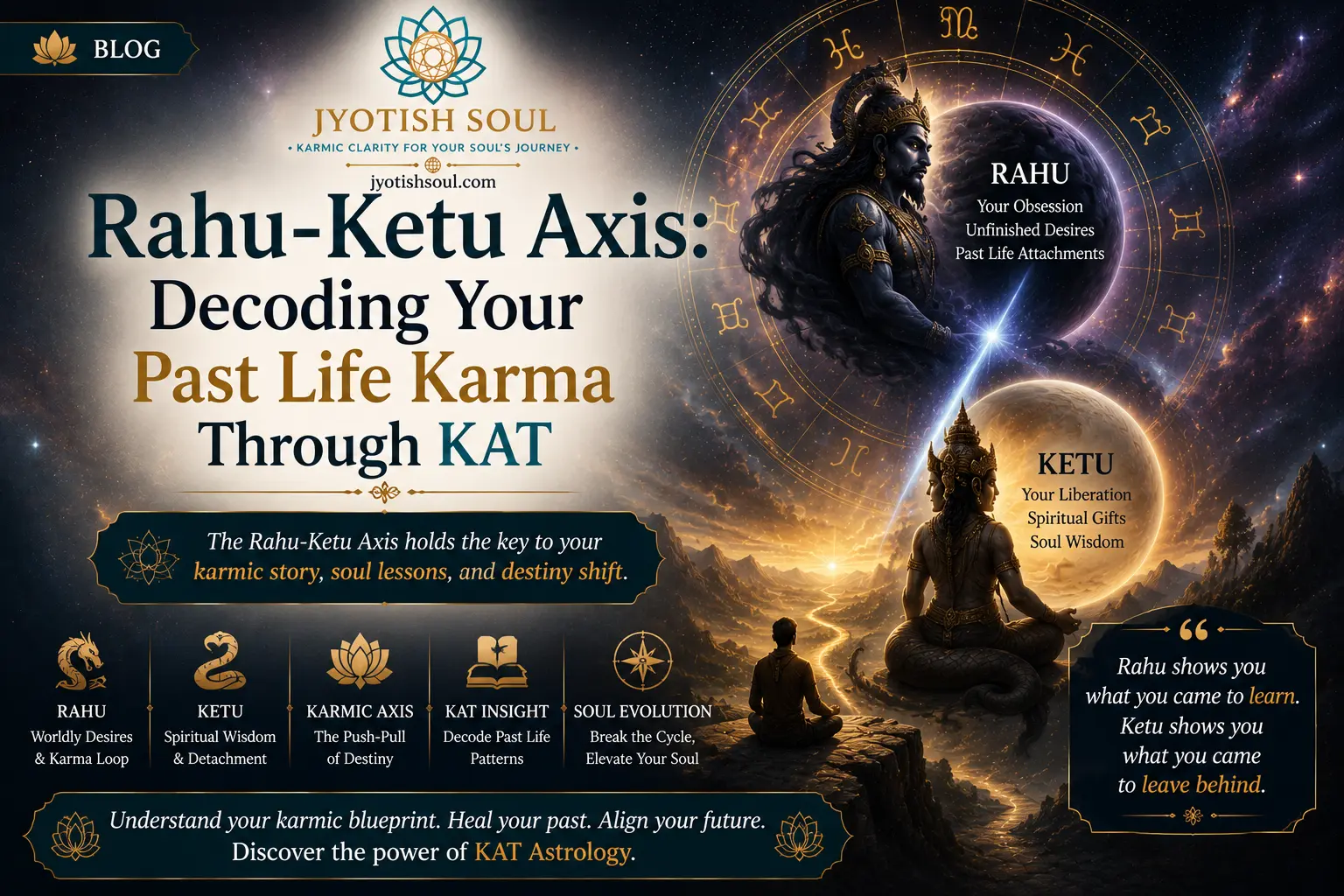
In Vedic astrology, Rahu (the North Node) and Ketu (the South Node) are always positioned exactly opposite each other in the zodiac — 180 degrees apart. They move together as a single karmic axis, never separating.
Rahu — The Head of the Shadow
Rahu represents:
- Worldly desire, ambition, and material pursuit
- The unknown, the foreign, and the unconventional
- Obsession, illusion, and insatiable hunger
- Sudden, unexpected events and transformation
- Future-oriented karma — what the soul is moving toward
Ketu — The Tail of the Shadow
Ketu represents:
- Past life mastery and accumulated spiritual wisdom
- Detachment, renunciation, and moksha (liberation)
- Loss, isolation, and the dissolving of what no longer serves
- Intuition, mysticism, and hidden knowledge
- Past-oriented karma — what the soul is releasing
The Karmic Story Told by the Rahu-Ketu Axis
In KAT, the Rahu-Ketu axis is read as a single, unified karmic narrative — not two separate, unrelated points, but one continuous karmic journey with two ends.
Ketu shows you where you have already mastered something — skills, wisdom, or experiences carried forward from past lives. Rahu shows you where your soul is now being pulled to grow — often into territory that feels unfamiliar, uncomfortable, or even frightening.
This is one of the most beautiful and practical teachings in Vedic astrology: your greatest growth in this lifetime lies in the direction of Rahu, but your innate gifts and foundation lie in the house and sign of Ketu.
Think of it this way: Ketu is the launchpad. Rahu is the destination. The soul’s journey in this incarnation is to use the mastery of Ketu as a foundation while courageously moving toward the unfamiliar growth that Rahu demands.
Why the Rahu-Ketu Axis Feels Uncomfortable
Almost everyone who studies their own Rahu-Ketu placement notices something: the house and sign where Rahu sits often represents an area of life that feels confusing, intensely desired, yet strangely unsatisfying no matter how much is achieved there. Meanwhile, the house and sign where Ketu sits often feels easy, almost too easy — sometimes to the point of boredom or a tendency to abandon that area prematurely.
This is not a flaw in the chart. It is the precise mechanism of karmic growth.
Ketu’s domain feels easy because the soul has already mastered it in previous incarnations. There is no real growth left there — only the temptation to stay in a zone of comfort and old identity.
Rahu’s domain feels difficult and obsessive because the soul has little to no prior experience there. It is genuinely new territory — exciting, magnetic, but also disorienting, because the soul has not yet built the skills or confidence that come naturally in Ketu’s domain.
KAT teaches that true alignment comes from honouring both ends of this axis — not abandoning Ketu’s gifts, but also not avoiding Rahu’s call to grow.
The Rahu-Ketu Axis and Saturn: A Powerful KAT Combination
Earlier in this series, we explored how Saturn — the Karma Karaka — reveals karmic themes through its conjunctions with other planets. The Rahu-Ketu axis adds another profound layer when it interacts with Saturn specifically.
Saturn Conjunct Rahu
When Saturn and Rahu conjoin, the karmic theme becomes one of intense, transformative ambition combined with karmic restructuring. This placement often indicates:
- A soul that is karmically driven to break old systems and build something entirely new
- Significant life disruptions that, while painful, clear the way for major transformation
- Themes of foreign lands, unconventional careers, or industries that did not exist in previous generations
- A tendency toward obsessive ambition that must be tempered with Saturn’s discipline and ethics
This combination, when aligned, often produces innovators, entrepreneurs, and those who reshape entire systems or industries — but the karmic lesson is always about channeling ambition through integrity rather than desperation.
Saturn Conjunct Ketu
When Saturn and Ketu conjoin, the karmic theme shifts toward deep detachment combined with spiritual or specialised mastery. This placement often indicates:
- Significant past-life expertise in a specific field, now being applied with humility in this lifetime
- A tendency toward isolation, introspection, and a sense of being “different” from peers
- Themes of loss or letting go that ultimately lead to spiritual depth
- A natural inclination toward research, healing, astrology, or behind-the-scenes work
This combination often produces healers, researchers, and spiritual practitioners — souls who carry old wisdom and are learning to apply it with detachment from worldly recognition.
The Rahu-Ketu Axis Through the Houses
While a complete analysis depends on your unique chart, here is a general overview of how the Rahu-Ketu axis expresses across the houses — useful for beginning to understand your own karmic direction.
1st-7th House Axis Karma around self versus partnership. Rahu in the 7th pulls toward relationships and partnership as the growth edge; Ketu in the 1st suggests past-life mastery of independence and self-reliance.
2nd-8th House Axis Karma around material values versus transformation. Rahu in the 8th draws the soul toward deep transformation, occult knowledge, and shared resources; Ketu in the 2nd suggests past mastery of values, family, and accumulated resources.
3rd-9th House Axis Karma around courage and effort versus higher wisdom. Rahu in the 9th pulls toward philosophy, higher learning, and expansive belief systems; Ketu in the 3rd suggests past mastery of communication, effort, and skill.
4th-10th House Axis Karma around emotional roots versus public career. Rahu in the 10th drives intense career ambition and public recognition; Ketu in the 4th suggests past mastery of home, emotional security, and inner foundations.
5th-11th House Axis Karma around creative self-expression versus social gain. Rahu in the 11th pulls toward networks, gains, and large-scale ambitions; Ketu in the 5th suggests past mastery of creativity, intelligence, and personal romance.
6th-12th House Axis Karma around service and struggle versus surrender and liberation. Rahu in the 12th draws the soul toward spiritual surrender, foreign connections, and loss of ego boundaries; Ketu in the 6th suggests past mastery of service, health discipline, and overcoming obstacles.
(Note: Rahu and Ketu axis positions mirror each other across all six house-pairs above — if Rahu is in one house of a pair, Ketu is automatically in the opposite house.)
Past Life Karma: What KAT Says About Where You’ve Been
One of the most common questions seekers bring to a KAT consultation is some version of: “What was I in my past life? What karma am I carrying?”
While KAT does not claim to provide literal, specific past-life biographical detail (no astrological system can verify this with certainty), it does offer something deeply useful: a clear map of the skills, tendencies, and unresolved patterns your soul carries forward.
Ketu’s house and sign, along with any planets conjunct with Ketu, reveal:
- Skills and talents that come unusually easily to you, almost as if you already knew them
- Areas of life where you may feel a strange sense of “been here before” déjà vu
- Patterns of detachment or loss that repeat until the underlying lesson is integrated
- Spiritual gifts — particularly when Ketu conjoins planets like Jupiter, Mercury, or the Moon
Meanwhile, Rahu’s house, sign, and conjunct planets reveal:
- The specific growth edge your soul has chosen for this incarnation
- Areas of intense, sometimes obsessive desire that point to unresolved karmic hunger
- The “homework” of this lifetime — skills and experiences your soul has not yet mastered
- Where sudden, unexpected, transformative events are most likely to occur
How to Align with Your Rahu-Ketu Karma
KAT emphasises that the Rahu-Ketu axis, more than perhaps any other karmic indicator, requires conscious balance. Here is how to begin aligning with this powerful axis:
1. Honour your Ketu gifts without overstaying Use the skills and wisdom that come easily to you (Ketu) as a foundation — but do not let comfort there become an excuse to avoid growth.
2. Move toward Rahu consciously, not compulsively Rahu’s pull can feel obsessive and ungrounded. The alignment is to pursue Rahu’s growth area with intention and ethics, rather than blind hunger or desperation.
3. Watch for extremes Both Rahu and Ketu can manifest in extreme ways when unintegrated — Rahu through excess, obsession, or illusion; Ketu through excessive withdrawal, isolation, or escapism. Awareness of this tendency is the first step to balance.
4. Use Ketu’s detachment to support Rahu’s ambition Paradoxically, the wisdom of detachment (Ketu) often makes Rahu’s pursuits more successful. When you chase your Rahu-driven goals without desperate attachment to the outcome, you tend to move toward them with far greater ease and grace.
5. Recognise the spiritual purpose of the axis Ultimately, the Rahu-Ketu axis exists to push the soul beyond comfort and toward growth — and eventually, toward the realisation that lasting peace cannot be found at either extreme, but in the integration of both energies.
Frequently Asked Questions
Q: Why don’t Rahu and Ketu have physical forms like other planets? Rahu and Ketu are mathematical points (the lunar nodes) rather than physical celestial bodies. In Vedic astrology, they are still treated as powerful karmic forces — sometimes called “shadow planets” — because of the profound influence they exert through eclipses and karmic patterning.
Q: Can the Rahu-Ketu axis change over a person’s lifetime? The natal Rahu-Ketu axis is fixed at birth and does not change. However, transiting Rahu and Ketu move through the zodiac (taking about 18 months to cross each sign) and activate different karmic themes as they transit through your chart over time.
Q: Is it bad to have Rahu or Ketu in a particular house? In KAT, no house placement of Rahu-Ketu is inherently “bad.” Each placement carries its own karmic curriculum — some more challenging in worldly terms, others more challenging in spiritual terms. The key is understanding and consciously working with whatever placement you have.
Q: How does the Rahu-Ketu axis relate to Saturn in KAT specifically? Since Saturn is the Karma Karaka in KAT, its relationship with the Rahu-Ketu axis (through conjunction or aspect) adds significant depth to understanding how karma from past patterns intersects with present-life discipline and effort. We explored this in detail earlier in this blog.
Q: Should I be afraid of my Rahu placement since it represents “unknown” territory? Not at all. While Rahu’s territory is unfamiliar, it represents your soul’s chosen direction for growth in this lifetime. Fear of it usually indicates exactly where the most meaningful expansion is waiting for you.
Discover Your Karmic Direction
The Rahu-Ketu axis is one of the most profound tools for understanding your soul’s journey — where you have been, what you have mastered, and where you are now being called to grow. Within the KAT framework, this axis becomes a practical map for conscious living rather than a source of fear or confusion.
At Jyotish Soul, our KAT consultations help you understand your unique Rahu-Ketu placement and how it interacts with Saturn and other key planets in your chart — giving you genuine clarity on your karmic direction.
🔮 Ready to decode your past life karma and soul direction? Book a KAT Consultation at Jyotish Soul →
Want a written analysis of your Rahu-Ketu axis to study at your own pace? Explore Our Karmic PDF Reports →
📖 Continue the KAT series:
- What Is Karma Alignment Technique (KAT)? →
- Saturn Conjunctions and Your Karmic Career Path →
- Jupiter-Saturn Conjunction: The Guru-Karma Code →
- Sun-Saturn Conjunction: Karmic Struggles That Build Your Soul →
- How Bhrigu Nandi Nadi Forms the Foundation of KAT Astrology →
Jyotish Soul offers karmic clarity through Vedic astrology, KAT, Parashari, Jaimini, and KP systems. Based in Dhenkanal, Odisha — serving seekers across India and the world.